
Reviewed · TUK-TUKS
Porto Guided Tour to the Historical Center on a Tuk Tuk
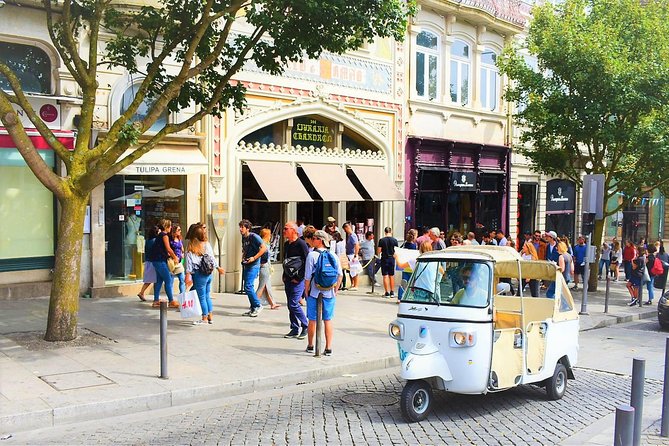
Porto packs a lot into a small, hilly center. This private tuk tuk tour is a smart way to get your bearings quickly, especially if your legs are not ready for steep lanes and long climbs. I like the access to narrow cobbled streets and the chance to reach viewpoints across the river, plus the included glass of Port wine. The main catch is that commentary can be hard to hear while the vehicle is moving, and traffic may eat into your sightseeing time.
The tour costs $42.33 per person and lasts about 1 hour 50 minutes. It is best used early in your stay, when you want a broad picture of Porto before returning to places on foot. Guides such as Ana, Anna, Victor, Bernardo, Fabian, Natalia, and Gonçalo have been praised for warmth, humor, city tips, and strong local knowledge, though the quality of guiding can vary.
In This Review
- Key points to know before booking
- Why a tuk tuk works well in Porto
- Starting near Porto Cathedral
- Bishop’s Palace and São Bento’s blue tile hall
- Praça da Liberdade, Lions Fountain, and Clérigos
- Cordoaria Garden and Porto’s theatrical side
- The Bolsa district and the Church of São Francisco
- Ribeira, Alfândega, and the Douro bridges
- The Serra do Pilar viewpoint and the Port tasting
- Price, guiding, and the small print that matters
- Who should book this Porto tuk tuk tour?
- FAQ
- How long does the Porto tuk tuk tour last?
- Where does the tour start and finish?
- How much does the tour cost?
- Is the tour private?
- How many people fit in one tuk tuk?
- Is Port wine included?
- Are monument entrance fees included?
- Is the tour available in English?
Key points to know before booking
- Porto in a small vehicle: A tuk tuk reaches lanes and overlooks that are awkward by bus or tiring on foot.
- A fast city orientation: In under two hours, you pass the cathedral, São Bento Station, Clérigos, Ribeira, the Douro bridges, and Vila Nova de Gaia.
- The Serra do Pilar viewpoint: The 15-minute stop gives you one of the finest broad views of Porto, Gaia, the river, and the bridges.
- A private experience: Only your own group takes part, with a minimum booking of two people.
- Port wine included: Your glass is part of the tour price, while monument entrance fees are not.
- Weather and traffic matter: The open-sided vehicle can be wet and windy, and road closures or congestion may change the route.
Why a tuk tuk works well in Porto
Porto is not a flat city. The historic center climbs from the Douro River toward the cathedral and Clérigos Tower, then drops sharply toward Ribeira. Streets are often narrow, paved, and busy with pedestrians. A tuk tuk saves you from turning the first hours of your visit into a fitness test.
The small vehicle is also useful for linking sights that feel close on a map but require tiring uphill walks. You can move from the cathedral area to São Bento, then on toward Clérigos, the Bolsa district, Ribeira, and the bridges without constantly checking your route.
I especially like this format for a first afternoon in Porto. You get the city’s basic shape, see where the river sits, and learn which places deserve a longer visit. Several stops are short, so this is not a substitute for exploring the interiors of Porto’s churches and monuments. Think of it as a moving orientation with selected photo breaks.
Each tuk tuk holds two, three, or four adults of average height, with a stated weight limit of up to 75 kilograms per person. Larger parties use more than one vehicle and travel together. If your group has six people, confirm the vehicle arrangement before setting out. One account described a six-person group feeling uneasy because the vehicle was designed for four and seatbelts were not available for everyone.
More History Tours in Porto
- Douro Valley: Historical Sites, Wine Experience, Lunch & Cruise
★ 5.0 · 5,133 reviews - Porto: Historic City Center Walking Tour
★ 4.7 · 1,172 reviews - Porto: An Intimate Fado Show in a Historical Tavern
★ 4.8 · 1,093 reviews
Starting near Porto Cathedral
The meeting point is on Rua de Augusto Rosa, near the cathedral and the upper part of the old center. That location puts you close to Porto’s medieval core from the first minute, but allow time to find the exact spot. One couple found the meeting point difficult to locate, and a late start can matter on a tour this short.
The first major stop is Porto Cathedral, or Sé do Porto. Construction began in the 12th or 13th century, and the building has been altered many times. Its present form is partly an idealized recreation of a medieval cathedral, so you are looking at both old fabric and later restoration.
You have about 10 minutes here, and entrance is not included. That is enough for a quick look and photographs, but not enough for a careful visit to every part of the cathedral complex. If you want to see the interior, ask your guide how much time remains and plan to return independently.
Nearby, the stone pelourinho on the cathedral terrace tells a more complicated story. The terrace itself was created in 1940 after buildings around the cathedral, including the Casa do Cabido and Bishop’s Palace, were demolished under the Estado Novo government. The present monument, built in 1945, copies a 1797 drawing.
That brief stop is free and lasts about five minutes. It is worth listening closely here because the open terrace offers a useful view of Porto’s upper city, but the stop is more about context than a long visit.
Bishop’s Palace and São Bento’s blue tile hall
The Paço Episcopal, or Bishop’s Palace, is another short stop. The building may date from the 13th century, possibly on older foundations, and was remodelled in 1737. The redesign is often linked to Nicolau Nasoni, the Italian architect associated with several important Porto Baroque works.
You will see its grand façade, framed windows, pilasters, and the central coat of arms of Bishop Rafael de Mendonça. Entrance is not included, and the five-minute pause is mainly for viewing the outside.
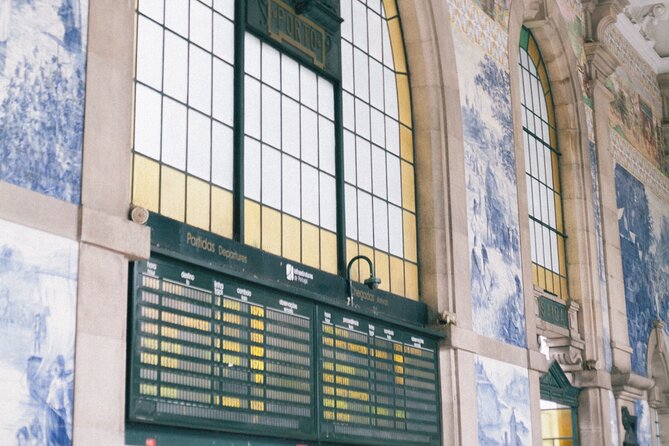
São Bento Railway Station is one of the tour’s most rewarding quick stops. The early 20th-century station has a glass and cast iron roof, but the real attraction is inside the entrance hall: about 20,000 painted tiles by Jorge Colaço tell scenes from Portuguese history and daily life.
You get roughly 10 minutes here, with free admission. That is enough to step into the hall and look upward, though I would return later if you care about tile work. The station is still a working transport hub, so it combines art with the ordinary movement of city life.
The tuk tuk format helps here because it drops you close to several central landmarks without asking you to solve Porto’s steep streets yourself. Still, keep your guide’s voice in range. Some people have found it difficult to hear explanations when the vehicle is moving.
Praça da Liberdade, Lions Fountain, and Clérigos
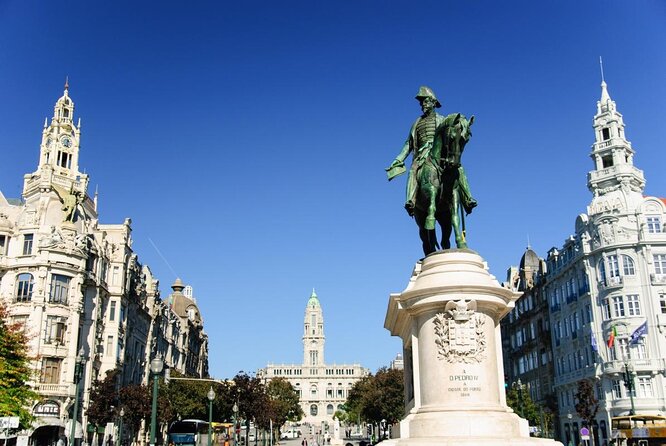
The route continues through Porto’s central squares, including the broad area that developed in the early 18th century as Praça Nova. Medieval walls and urban palaces once bordered the space, but the city has changed greatly since then.
You then reach the area associated with Praça de Carlos Alberto. For centuries it was known as Praça dos Ferradores, after the blacksmiths who worked there. The square later took its current name in honor of Charles Albert of Sardinia, who lived in exile in Porto. A monument in the garden remembers Portuguese people who died in the First World War.
Fonte dos Leões, or Lions Fountain, is a five-minute free stop. Built in the 19th century by a French water company, it was cast at the Val d’Osne foundry in France. Its design is largely copied from the fountain in Leicester’s Town Hall Square. That small detail is easy to miss when you are rushing between famous churches, and it is exactly the kind of extra fact that can make a short city tour more interesting.
The Clérigos area brings you to one of Porto’s clearest symbols. The Clérigos Church is a Baroque building, while its tall bell tower can be seen from many parts of the city. You have about five minutes here, and the tower entrance is not included.
Do not expect time to climb the tower during this tour. The stop is for orientation and a close look at the exterior. If you want the city panorama from the top, return later and buy a separate ticket.
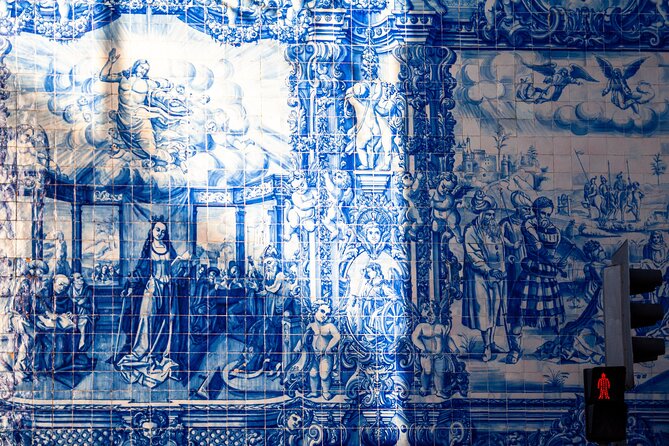
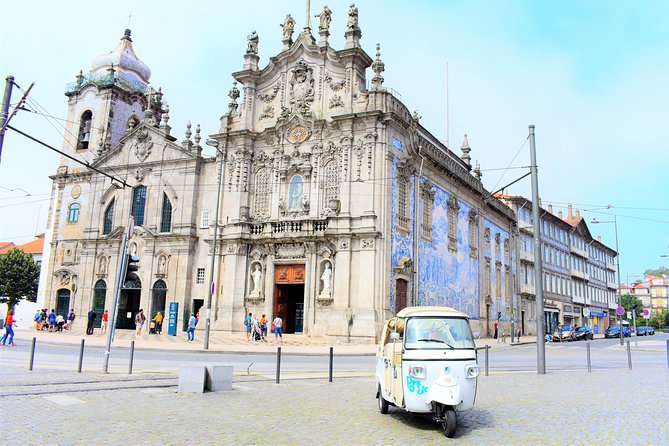
The route also passes two important churches. One is a 17th-century church with a classical façade from the 1850s and a Rococo altarpiece linked to Nasoni’s circle. The other was built in the second half of the 18th century and is known for Porto Rococo carving and a tiled side façade added in 1912. The tile designs by Silvestre Silvestri show scenes connected with devotion to Our Lady.
These churches are among the places where a moving tour can feel frustrating. You may see the outside, hear a useful introduction, and then continue before you have time to study the carvings. Write down the names or ask the guide to point them out clearly so you can revisit them.
More Tuk Tuk Tours in Porto
- Porto: Guided Tour by Tuk-Tuk & Optional Douro River Cruise
★ 4.5 · 5,980 reviews - Discover Porto’s Highlights on a 2-Hour Private Electric Tuk Tuk
★ 4.5 · 1,860 reviews - Historic Porto by Private Electric Tuk Tuk to Top Landmarks
★ 4.5 · 735 reviews - Porto: Private Sightseeing Tour by Electric Tuk Tuk
★ 4.8 · 305 reviews
Cordoaria Garden and Porto’s theatrical side
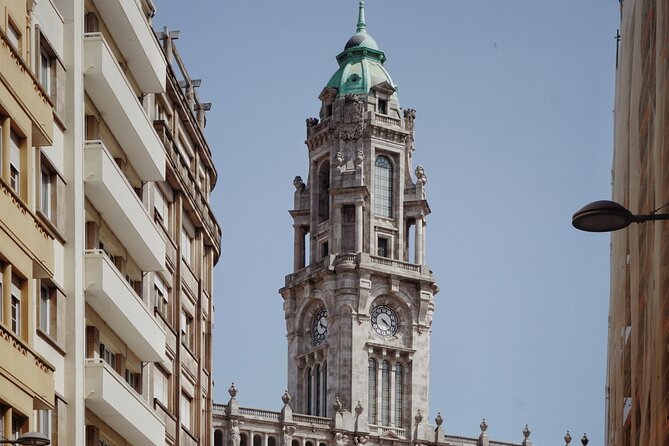
Cordoaria Garden, officially João Chagas Garden since 1924, gives the tour a pause from churches and stone plazas. Its popular name recalls the rope makers who worked here for about 200 years. The municipality converted the area into a public garden in the 19th century, following a plan by German landscaper Emile David.
The garden contains statues of Ramalho Ortigão and António Nobre, along with modern sculptures by Juan Muñoz and a work called The Kidnapping of Ganymede. It was remodelled during Porto’s 2001 year as European Capital of Culture.
The tour also passes the classic theatre building connected with the Carlos Alberto Theatre and São Bento da Vitória monastery. The building was constructed in 1910 after the Real Theatre burned in 1908. Its façade carries symbolic emblems for pain, quality, hate, and love, and its design reflects the Luís XVI style popular in France during the early 20th century.
This is a good example of the tour’s range. Porto is not only medieval lanes and ornate churches. It also has theatres, gardens, railway architecture, modern cultural spaces, and layers of civic change.
The Bolsa district and the Church of São Francisco
The Palácio da Bolsa, or Stock Exchange Palace, is one of Porto’s major monuments. Built in a Neoclassical style from 1842, it belongs to the Commercial Association of Porto. Its Arabian Room is the celebrated interior, but you will need a separate admission ticket to see it properly.
The palace is also part of Porto’s Urban Wine Route, which fits neatly with the Port tasting later in the tour. If you enjoy architecture, plan a return visit, since five or ten minutes outside cannot do justice to the building.
Nearby, the Monument to Infante D. Henrique honors Portugal’s age of navigation and faith. Its construction began in 1894 and ended in 1900. The square also includes Mercado Ferreira Borges, an iron market building dating from 1885 that now houses Hard Club.
The market’s short working life is part of its story. It replaced the older Ribeira Market, then served other purposes before becoming an entertainment venue. Its iron structure gives you another look at Porto’s 19th-century engineering.
The Church of São Francisco is the major religious highlight in this section. Construction began in the 14th century, but the interior is famous for the vast amount of gilded woodwork added in the 17th and 18th centuries. The Tree of Jesse and catacombs are especially worth seeking out.
The church is a National Monument and part of Porto’s UNESCO-listed historic center. Entrance is not included, and the tuk tuk visit is only an introduction. If you have time for one paid church interior after the tour, this is a strong candidate.
Ribeira, Alfândega, and the Douro bridges
The route reaches the riverfront and the Ribeira area, where Porto’s old center meets the Douro. You may pass the Alfândega Nova do Porto, a 19th-century Neoclassical customs building facing both the river and the city.
Its construction combines iron with stone, brick, and wood according to the needs of each space. Today it houses the Museum of Transport and Communications, along with a congress center. The tour does not include museum admission, but the building itself is an important part of the riverfront view.
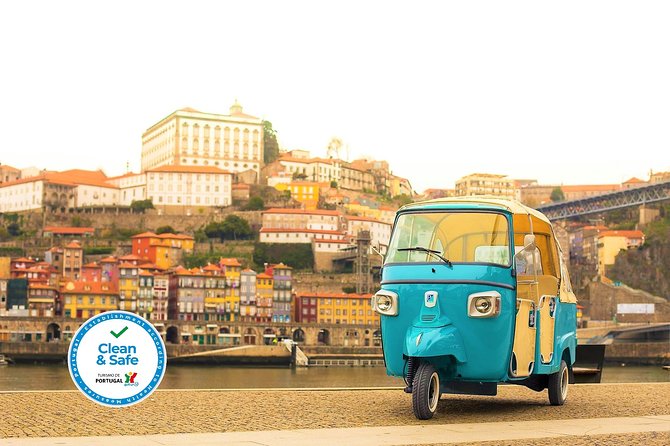
This is also the point where the city’s geography begins to make sense. Porto rises on the north bank, Vila Nova de Gaia occupies the south bank, and the bridges tie the two together. A tuk tuk gives you a quick look at this relationship without requiring a long walk along the water.
The D. Luís I Bridge is the star. Designed by Teófilo Seyrig, a disciple of Eiffel, it opened in 1886 with two overlapping iron decks. Its 395-meter length and huge forged-iron arch make it one of Porto’s most recognizable structures. Today, the upper deck carries Porto Metro between the cathedral area and Gaia.
You also pass the Infante Bridge, opened in 2003 to replace road use of the upper deck of D. Luís I after the metro took over. Its high arch and clean lines offer a sharp contrast with the older bridge.
Traffic is the key risk in this riverfront section. One disappointing outing lost close to half an hour in congestion. The company also notes that street closures, including works connected with new metro lines, can force changes or even cancellation. The route is not fully insulated from Porto’s road conditions.
The Serra do Pilar viewpoint and the Port tasting
The 15-minute stop at Mosteiro da Serra do Pilar is likely the tour’s visual high point. The monastery is a UNESCO World Heritage site, begun in 1538 and completed around 1670. Its circular church and circular cloister are unusual, with the cloister supported by 36 Ionic columns.
The terrace looks across the Douro toward Porto’s riverside, the cathedral, D. Luís I Bridge, the Arrábida Bridge, Fontainhas, and São João Bridge. This is where the tour earns its keep for first-time visitors. You can finally see how the hills, river, historic center, and Gaia side fit together.
Several guides, including Ana, Anna, and Gonçalo, have made this viewpoint a memorable part of the experience. Gonçalo also received praise for clear communication and for making the two-hour route work well for a family with children aged three and five.
At some point during the route, you receive a glass of Port wine. It is a modest inclusion, not a winery visit or tasting class, but it connects the city tour with Porto’s best-known drink. Enjoy it as a local accent rather than the main event.
The vehicle may be open to the weather, so bring a raincoat even if the forecast looks harmless. A wet and windy day can change the mood quickly. The activity requires good weather, and a cancellation for poor conditions should result in either another date or a full refund.
Price, guiding, and the small print that matters
At $42.33 per person, the tour offers fair value if you want transport, a private guide, a broad route, and a Port tasting in one compact outing. It is less attractive if you plan to walk easily, already know Porto’s layout, or want long interior visits.
The private format is a real advantage. You are not sharing the vehicle with strangers, and a good guide can respond to your interests. Victor has been praised for pairing city information with restaurant advice. Ana and Anna are described as friendly, funny, and energetic. Natalia, Bernardo, Fabian, and Gonçalo have also been singled out for clear explanations and a pleasant manner.
But guiding is not perfectly consistent. A few outings have suffered from weak commentary, limited explanation while driving, or a guide who simply pointed toward sights. Before the vehicle moves, tell your guide what matters to you: churches, architecture, photographs, food, viewpoints, or city orientation. Ask them to pause before driving if you need to hear the explanation.
The tour requires at least two people. Children must have an adult with them, and service animals are allowed. Most people can participate, but the vehicle’s small size and Porto’s uneven streets may not suit every mobility need. Confirm details with the provider if that affects your plans.
You can cancel free of charge up to 24 hours before the start time. Changes made inside that window are not accepted for a refund. The activity ends back at the starting point, and the schedule may shift because of local traffic.
Who should book this Porto tuk tuk tour?
I would choose it for a first day in Porto, a short stay, families, couples, and anyone who wants to cover hills without wearing out their feet. It is also useful for photographers because the route links many viewpoints and lets you mark places to revisit.
I would not choose it as my only Porto sightseeing activity. The short stops and excluded entrance fees mean you will still need time on foot for São Bento’s tile hall, São Francisco, the Bolsa Palace, the cathedral, and Clérigos Tower.
Book it if you value speed, private transport, and a city overview. Skip it if your favorite travel rhythm is slow wandering, long museum visits, and detailed time inside each monument. For most first-time visitors, the best plan is simple: take the tuk tuk early, note the places that catch your eye, then spend the next day exploring those sites on foot.
FAQ
How long does the Porto tuk tuk tour last?
The tour lasts approximately 1 hour 50 minutes.
Where does the tour start and finish?
It starts at R. de Augusto Rosa 180, 4000-528 Porto, Portugal, and ends back at the same meeting point.
How much does the tour cost?
The listed price is $42.33 per person.
Is the tour private?
Yes. Only your own group takes part in the activity.
How many people fit in one tuk tuk?
Each tuk tuk holds two, three, or four adults of average height, with a stated limit of up to 75 kilograms per person. Larger groups use multiple vehicles and travel together.
Is Port wine included?
Yes. A Port wine glass is included in the tour price.
Are monument entrance fees included?
No. Entrance fees for monuments are not included.
Is the tour available in English?
Yes. The tour is offered in English, and a driver guide and local guide are included.
More Heritage Sites and Old Towns
- Porto: Historical Center Walking Tour
★ 4.8 · 898 reviews - Porto:Private Tour of the Historic City in a Classic Ford T
★ 4.8 · 716 reviews - 3-Hour Porto Jewish Heritage Walking Tour with Local Guide
★ 4.5 · 396 reviews - Porto:Private Tour of the Historic City in a Classic Ford T
★ 5.0 · 307 reviews
More Tuk Tuk Rides
- Oporto Tuk-Tuk Tour: Fast, Fun & Flexible – 1H to Full Day!
★ 4.7 · 280 reviews - Porto Half Day Private Tuk Tuk Tour
★ 4.5 · 246 reviews - Porto Tuk Tuk: Clérigos, Seaside & Viewpoints – with Options
★ 5.0 · 202 reviews - True 4Hour Private Tuk Tuk Tour: Discover Lisbon with a Local!
★ 5.0 · 8,008 reviews
Just added around Porto
- Matosinhos: Conservas Pinhais Factory Tour★ 4.8 · 173 reviews
- Private Geres National Park Tour with Lunch and Transfers★ 5.0 · 174 reviews
- Porto: Tour on the Douro River in a Classic Boat★ 5.0 · 178 reviews
- Porto: Santiago de Compostela and Valença do Minho Day Trip★ 4.5 · 181 reviews
- Porto: 6 Bridges Port Wine River Cruise with 4 Tastings★ 4.8 · 182 reviews
- Private Rafting Experience in Melgaço★ 5.0 · 186 reviews
- Tile Painting and Cocktails in Downtown Porto★ 5.0 · 187 reviews
- Porto: Combined Ticket for WOW Cultural District★ 4.7 · 188 reviews
Tuk-Tuks, compared.
True 4Hour Private Tuk Tuk Tour: Discover Lisbon with a Local!
Read our review →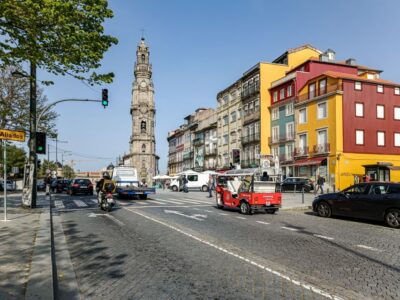
Guided Tour by Tuk-Tuk & Optional Douro River Cruise
Read our review →
Private Lisbon Sightseeing Tuk-Tuk Tour: Alfama, Belém & More
Read our review →
Lisbon Highlights: Private Tuk Tuk Tour Adventure Sightseeing
Read our review →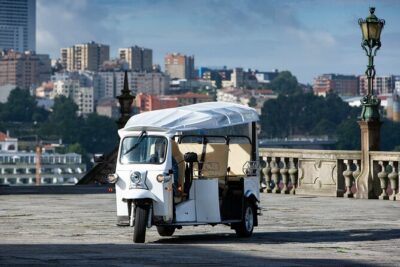
Discover Porto’s Highlights on a 2-Hour Private Electric Tuk Tuk
Read our review →
Welcome Lisbon Tour with Local Guide in Private Eco Tuk Tuk
Read our review →
Browse the lists this tour appears in