
Reviewed · PORT WINE CELLAR TOURS
Porto: Tile Painting Workshop with Tea and Port Wine
Make a souvenir you can actually use. This two-hour Porto workshop combines the city’s famous tile tradition with hands-on painting, tea, biscuits, and the chance to take home two tiles you designed yourself. I like the clear connection to Porto’s streets and buildings, and I like that the finished pieces are fired and packaged rather than handed back as fragile wet projects. The main catch is practical: you must return the next day, and the opening history talk may feel a little long if you mainly want painting time.
The workshop takes place near Campanhã train station and the TIC bus terminal, making it useful if you are staying or passing through this part of Porto. I also like the small-group option and the multilingual instruction in English, French, or Japanese. Parking is not especially easy in the area, so public transport or a taxi may be less stressful than bringing a car.
In This Review
- Key points to know before booking
- Why Portuguese tiles matter in Porto
- Arriving near Campanhã station
- The first part: tea, biscuits, and tile stories
- Learning the tile-painting method
- Painting two Porto-inspired tiles
- The kiln turns your work into a keepsake
- How much value does the $53 price offer?
- Who will enjoy this workshop most?
- Small details that make the class work
- Should you book the Porto tile workshop?
- FAQ
- How long does the tile painting workshop last?
- How many tiles do I paint?
- Are painting materials included?
- Can I take the tiles home immediately?
- When do I collect the finished tiles?
- Is packaging provided for the tiles?
- Where is the workshop located?
- Which languages are available?
- Is the class suitable for a small group?
- Can I cancel for a full refund?
Key points to know before booking
- You paint two tiles each: This is better value than a single quick souvenir and gives you room to try different designs.
- The tiles are fired after class: Pick them up about 24 hours later, packed for the journey home.
- Porto’s tile tradition comes first: The class explains why tiles appear on houses, monuments, and heritage buildings across Portugal.
- The workshop suits families: An 8-year-old, a teenager, and adults all took part successfully in one family group.
- The setting is near Campanhã: The train station and TIC bus terminal make arrival simple, but the area is not very car-friendly.
- Tea and biscuits are included: Port wine is part of the experience title, but the included details specifically confirm tea and biscuits, so check the serving details when booking.
Why Portuguese tiles matter in Porto
Porto is a city where decoration is often built into the walls. Blue-and-white panels, patterned facades, and tiled churches are not just pretty backdrops for photographs. They help tell stories, protect building surfaces, and give ordinary streets a strong local identity.
That context gives this workshop more weight than a standard craft class. Before you pick up a brush, the guide explains how tiles became important in Portuguese art and culture, and where you see them in homes, monuments, and heritage buildings. You begin to look at Porto differently after learning that the little squares covering a facade are part of a long national tradition.
I appreciate this introduction because it gives your painting a purpose. You are not simply copying a random pattern onto a ceramic square. You are working with shapes and motifs linked to the city around you.
The history section is not everyone’s favorite part. One family felt it could have been shorter, with more time devoted to painting. If you already know Portuguese tile art well, you may share that view. If this is your first trip to Portugal, though, the background helps explain why the craft deserves more than a quick souvenir-shop glance.
More Wine Tours in Porto
- From Porto: Douro Valley w/ Boat Tour, Wine Tasting & Lunch
★ 4.7 · 19,061 reviews - Complete Douro Valley Wine Tour with Lunch, Wine Tastings and River Cruise
★ 5.0 · 12,920 reviews - Porto: Live Fado Show with Glass of Port Wine
★ 4.8 · 6,498 reviews
Arriving near Campanhã station
The workshop is near Porto’s Campanhã train station and the new TIC, or Terminal Intermodal de Campanhã. A school and a taxi rank sit beside the station, which helps you identify the general area.
This is not the postcard center of Porto, so do not expect to step straight from the workshop into the city’s most scenic streets. The advantage is transport. If you arrive by train or intercity bus, the location can fit neatly into your day without a long trip across town.
I would plan your timing carefully. You need to attend the two-hour class, then return about 24 hours later to collect the fired pieces. That makes this activity easiest when you have at least two nights in Porto. If you are in town for one night only, the pickup requirement makes it a poor fit.
Comfortable shoes and comfortable clothing are sensible choices. You will be sitting and working with art materials, and this is not the moment for your most delicate outfit.
Parking is a weak point. The area is not especially friendly for cars, so I would avoid building your plan around easy street parking. Public transport or a taxi should be the simpler option, especially if you are carrying luggage.
The first part: tea, biscuits, and tile stories
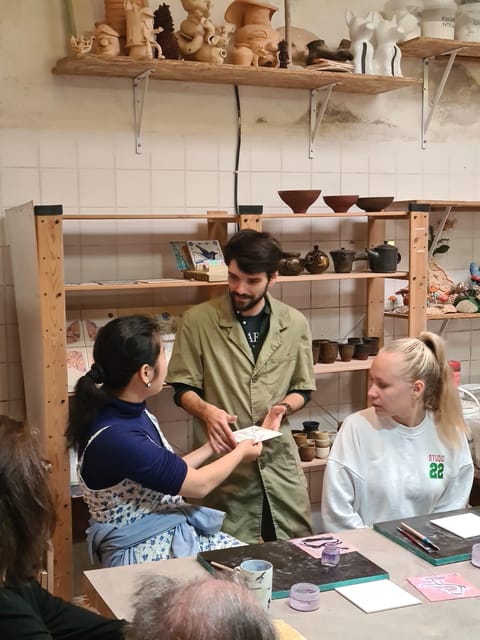
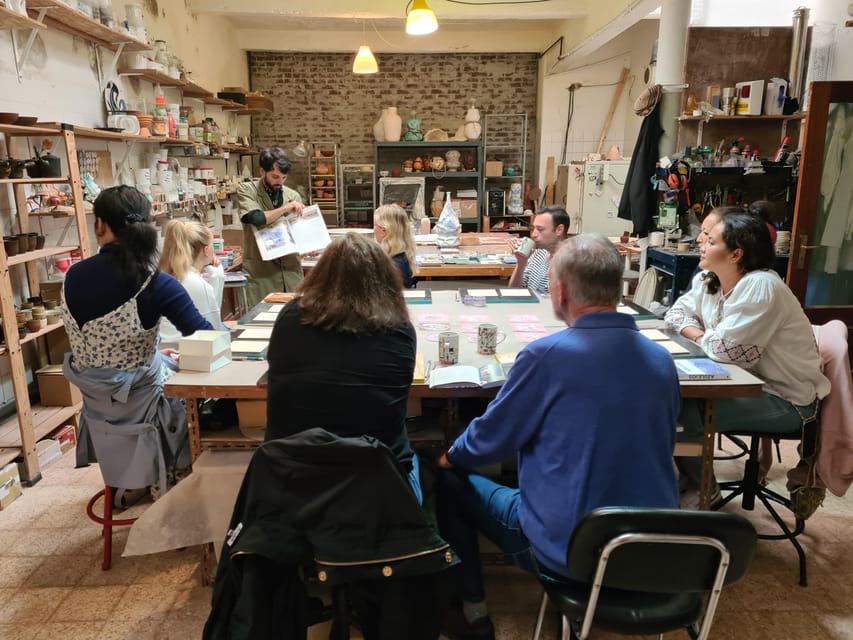
The class opens with an introduction to the history and meaning of Portuguese tiles. You may also have tea and biscuits while looking at examples and browsing the studio.
This slower start helps you get oriented. You can see the sort of patterns used in Portugal and ask questions before making your own design. One group was served a self-planted herbal infusion, adding a pleasant personal touch to the welcome.
The experience is described with tea and Port wine, while the included details list tea and biscuits. Since the supplied information is not fully specific about how Port is served, I would confirm that point if it is central to your plans. Either way, the tea break gives the class a relaxed, friendly opening rather than sending you straight to a blank tile.
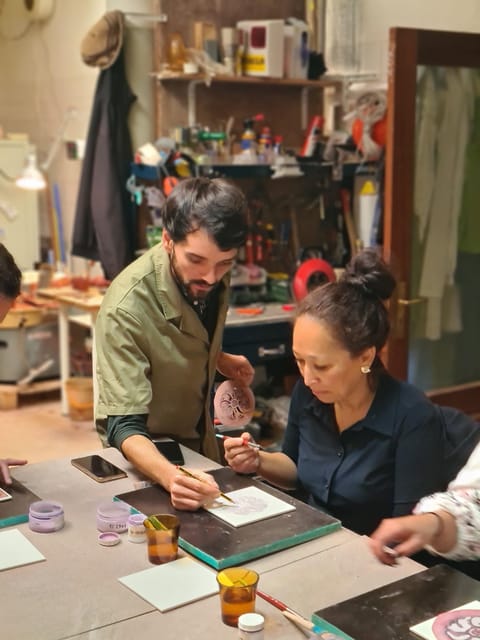
The studio itself is part of the appeal. You are working in an artist’s workshop, not a generic hotel meeting room. That setting makes it easier to understand that tile painting is a real craft with its own tools, methods, and decisions.
The guide introduces different types of tiles and examples of decorative sculptures used in Portugal. That visual material can be especially useful for children and anyone who has trouble imagining a finished design from a verbal explanation.
Learning the tile-painting method
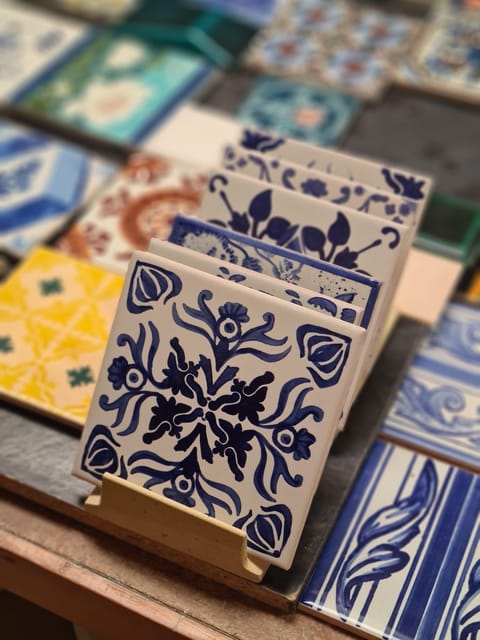
Once the introduction is complete, the artist explains the techniques used to produce traditional Portuguese tiles. You learn how to approach the surface, how traditional motifs are built, and what to expect when the tile goes into the kiln.
You do not need to arrive with an art background. The workshop provides all materials and gives you instructions before you begin. Stencils are available too, which is helpful if you like the look of traditional patterns but do not trust your freehand drawing.
At the same time, the stencils do not do the whole job for you. The artist and assistant are there to answer questions and offer creative advice, but they do not simply complete the tile on your behalf. That balance is important. You receive support without losing the satisfaction of making the design yourself.
I like this approach because it gives you two ways to take part. You can follow a traditional motif with the help of a stencil, or you can create something more personal. The result does not have to look like a professional ceramic panel to be meaningful. Slightly uneven lines may be part of what proves you made it yourself.
The instructor languages are English, French, and Japanese. If you need the class in French or Japanese, state that when booking. Otherwise, you may be placed in the English session.
More port cellar visits:
- Porto: Cockburn’s Port Lodge Tour and Tasting
★ 4.8 · 3,360 reviews - Porto: Bridges Cruise with Wine Cellar Tour or Sunset Option
★ 4.1 · 2,758 reviews - Porto: Authentic Fado Show, Port Wine & Handmade Instruments
★ 4.8 · 2,737 reviews - Porto: City Train Tour, River Cruise & Wine Cellar
★ 3.9 · 2,601 reviews
Painting two Porto-inspired tiles
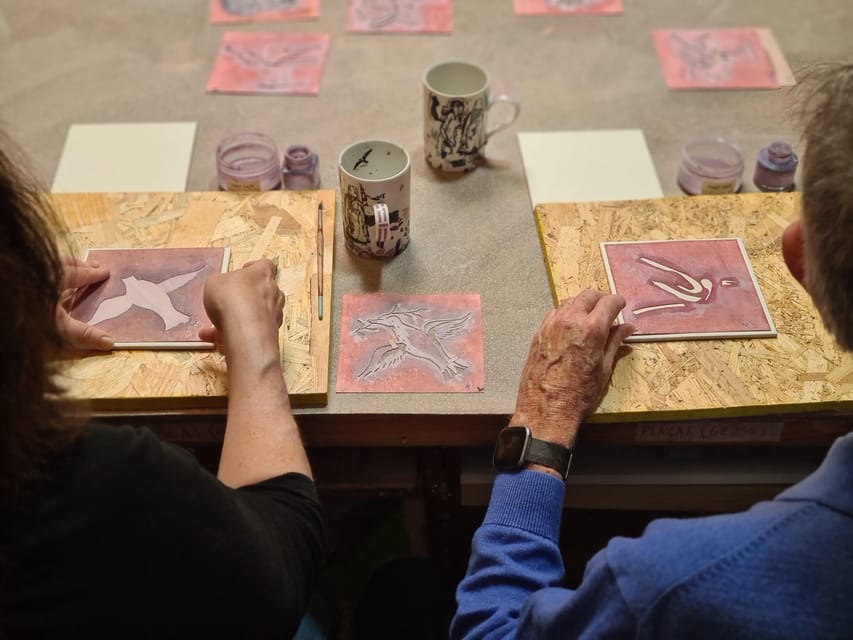
The main activity is painting two tiles inspired by traditional Portuguese designs. The two-tile allowance is one of the best features here. One tile lets you make a single attempt. Two give you more freedom to try contrasting colors, repeat a pattern, or make a matching pair.
You can use the available examples and stencils for ideas, but the creative choice remains yours. The artist provides guidance while you work, and you can ask for feedback as your design develops. Families can share the activity across ages, though younger children may need help with the practical side of painting.
A family group with an 8-year-old and a teenager found the session worked well for everyone. That makes this a strong family choice when you want an activity that is quieter and more creative than another sightseeing stop.
The timing is the one thing to watch. The class lasts two hours, but some of that time goes to the introduction, tea, examples, and instructions. If your main goal is to paint, you may wish the opening talk were shorter. I would not book this expecting two uninterrupted hours at the worktable.
On the other hand, the teaching is a key part of what you are paying for. Without it, you could simply buy a blank tile and paint it yourself. Here, the history and technique turn the craft into a cultural experience.
The kiln turns your work into a keepsake
You do not leave with the final tiles immediately. After you finish painting, the pieces are fired in a kiln. They are ready for pickup around 24 hours later, usually the next morning at about 11:00 or 12:30.
This extra step makes the souvenir more durable and more authentic to the process. Firing fixes the design and transforms your painted work into a finished ceramic object. The workshop also provides proper packaging, which matters if you are flying or taking a train with a full suitcase.
The return visit requires planning. Ask yourself where you will be at the pickup time, and leave enough room in your schedule. If you have a morning departure, the tiles may be difficult or impossible to collect. I would book the workshop early in your stay rather than on your final afternoon.
The next-day pickup has one pleasant benefit: it gives you another reason to pass through the area and collect a personal reminder of Porto rather than buying a mass-produced magnet at the airport.
How much value does the $53 price offer?
At $53 per person, the workshop is not the cheapest craft activity you will find. The price includes two tiles, all painting materials, instruction, firing, packaging, and tea with biscuits. Those included elements make the cost easier to justify than a basic one-tile class.
You are also paying for access to an artist’s working knowledge. The guide explains the place of tiles in Portuguese culture, shows examples, teaches the method, and offers advice while you paint. That combination is more useful than simply renting a table and a few brushes.
The two finished tiles are the biggest value point. You get a pair of handmade souvenirs, and the personal connection usually matters more than the retail price of a ceramic object. I would especially consider it good value for a family, since everyone can work on their own pieces and take home something different.
The value is weaker if you are in Porto for only one night, dislike scheduled activities, or have no interest in making things. You could spend $53 on several smaller attractions, and this workshop requires a second visit for pickup.
Cancellation is free up to 24 hours before the activity, and you can reserve now and pay later. The class needs at least two participants, so it may be canceled if that minimum is not reached by the day before. Keep that possibility in mind when arranging your schedule.
Who will enjoy this workshop most?
I would recommend it first to people who want a souvenir with a story. You will remember the tile not only because it came from Porto, but because you painted it, waited for it to be fired, and returned to collect it.
It is also a strong choice for:
- Families with children and teenagers
- Couples who want a shared creative activity
- Visitors interested in Portuguese design and architecture
- Anyone looking for a break from churches, museums, and city walking
- People staying in Porto for at least two nights
- Art-minded visitors who enjoy guidance without a rigid class format
You may want to skip it if you have limited time, cannot return the next day, or prefer fast-paced sightseeing. It is also less suitable if parking is essential to your plans.
The atmosphere sounds warm and welcoming, with the guide and assistant available for questions. David received especially strong praise for his personal approach, creative suggestions, and ability to answer questions for a family group. The provider is Francisco Pessegueiro, and the workshop has earned a 4.9 rating from 66 bookings, which points to a consistently well-received experience.
Small details that make the class work
Several practical touches improve the experience. The workshop supplies every material you need, so you do not have to shop for brushes, paints, or ceramic tiles before arriving. Comfortable clothes are enough.
The staff also lets you browse the studio, and you can buy additional items there if something catches your eye. That gives you a chance to compare your own work with finished pieces without turning the class into a sales presentation.
Small-group availability should make it easier to ask questions and receive help. This matters most when you are deciding how much paint to use or trying a design for the first time. Instruction in three languages also opens the experience to more visitors.
I would arrive ready to experiment rather than aiming for perfection. The point is not to produce a museum-quality panel in two hours. The point is to understand a little of the craft and leave with two objects carrying your own mark.
Should you book the Porto tile workshop?
Book it if you have two days in Porto, enjoy hands-on activities, and want a personal souvenir. The combination of tile history, studio instruction, two painted tiles, kiln firing, and next-day packaging gives the $53 price solid value.
I would place it early in your stay so the pickup is easy. Use public transport or a taxi if possible, and confirm the Port wine details if that part of the title matters to you. Families, couples, and curious first-time visitors are likely to get the most from it.
Skip it if your schedule ends before the next morning or if you want every minute devoted to sightseeing. For everyone else, this is a pleasant way to understand one of Porto’s most visible art forms and take home a souvenir you made with your own hands.
FAQ
How long does the tile painting workshop last?
The workshop lasts two hours.
How many tiles do I paint?
You paint two tiles during the class.
Are painting materials included?
Yes. All materials needed for tile painting are included.
Can I take the tiles home immediately?
No. The tiles must be fired first. They are ready for pickup about 24 hours after the class.
When do I collect the finished tiles?
Pickup is scheduled for the next morning, usually around 11:00 or 12:30.
Is packaging provided for the tiles?
Yes. The finished tiles are provided with proper packaging.
Where is the workshop located?
The store is near Campanhã train station and the TIC Terminal Intermodal de Campanhã bus station. A school and a taxi rank are beside the station.
Which languages are available?
Instruction is available in English, Japanese, and French. If you want French or Japanese, state your preferred language when booking.
Is the class suitable for a small group?
Yes. A small-group option is available.
Can I cancel for a full refund?
Yes. You can cancel up to 24 hours in advance for a full refund.
More Vineyard Visits and Tastings
- Douro Valley: Wine Tour with Lunch, Tastings & River Cruise
★ 4.6 · 6,081 reviews - Douro Valley: Historical Sites, Wine Experience, Lunch & Cruise
★ 5.0 · 5,133 reviews - Authentic Small Group Douro Wine Tour with Lunch & River Cruise
★ 5.0 · 4,775 reviews - Douro Valley Small-Group Tour with Wine Tasting, Lunch and Boat
★ 5.0 · 3,642 reviews
Just added around Porto
- From Arouca: Paiva River Canoe Rafting Adventure Tour★ 5.0 · 46 reviews
- Jewish Walking Tour of Porto★ 4.5 · 46 reviews
- Porto Private Gourmet Food & Wine Historic Tour with a Sommelière★ 5.0 · 46 reviews
- Santiago and Valença do Minho Full Day Private Tour★ 5.0 · 47 reviews
- Porto: Aveiro with cruise, Costa Nova, Capelha do Senhor da Pedra★ 4.5 · 47 reviews
- Best of Porto Guided Tour: Cruise & Wine Tasting★ 4.5 · 47 reviews
- Water Canyoning★ 5.0 · 47 reviews
- Cruise Shore Excursion – Private Tuk Tuk Tour to the Historic Center★ 4.5 · 47 reviews
Port Wine Cellar Tours, compared.

Live Fado Show with Port Wine in Historic Center
Read our review →

Bridges Cruise with Wine Cellar Tour or Sunset Option
Read our review →
Authentic Fado Show, Port Wine & Handmade Instruments
Read our review →

Live Fado Concert with Glass of Tawny Port Wine
Read our review →
Port Wine Lodges Tour Including 7 Port Wine Tastings (English)
Read our review →Browse the lists this tour appears in