
Reviewed · HISTORICAL TOURS
Jewish Sephardic history in Lisbon
Lisbon’s Jewish past is mostly hidden in plain sight. This four-hour walk links the Shaare Tikva Synagogue with the neighborhoods, squares, churches, and memorial sites that help explain Jewish life in Portugal. I like the intimate group size, capped at eight, and the chance to enter Lisbon’s historic synagogue with admission included. The guide Paulo Levy earns especially high praise for connecting Portuguese history with his own rediscovered Jewish heritage.
The main drawback is the amount of walking. The route can cover about four miles, with hills, narrow streets, and steps, and much of the old Jewish presence has vanished. If you expect a string of preserved Jewish buildings, you may be disappointed. This is a story-led city walk, not a museum tour with a Jewish landmark at every corner.
In This Review
- Key points to know before booking
- Starting at Shaare Tikva Synagogue
- From Principe Real to Chiado
- Bertrand Bookstore and a Jewish literary connection
- Praça do Comércio and the turning points of Portugal
- Rossio Square and the old Inquisition center
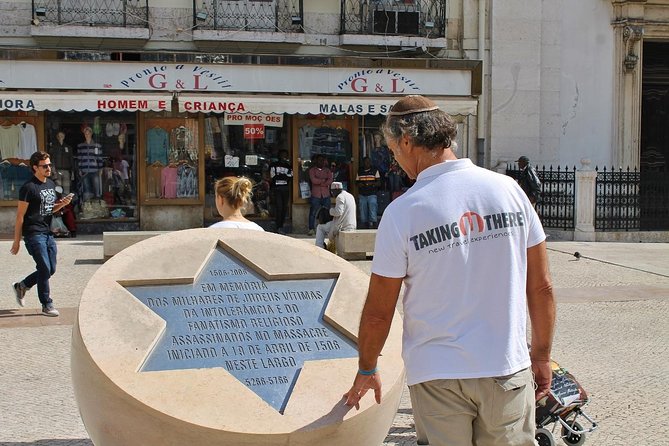
- Igreja de São Domingos and the 1506 massacre
- What the four hours feel like
- The value of $84.10
- Who will enjoy this walk most
- Practical advice for a better day
- Should you book Jewish Sephardic History in Lisbon?
- FAQ
- How long does the Jewish Sephardic history tour last?
- Where does the tour start?
- Where does the tour end?
- Can I visit inside the synagogue on any day?
- What is included in the price?
- How much walking is involved?
Key points to know before booking
- Shaare Tikva is the essential first stop: You go inside Lisbon’s synagogue, with an introduction to its community and history.
- Paulo Levy brings personal meaning: His own journey toward discovering his Jewish roots gives the subject a warm, human voice.
- The Jewish sites are often invisible: Lisbon’s 1755 earthquake, fires, tsunami, and centuries of Inquisition erased or altered much of the earlier physical record.
- Expect a serious walk: The route moves from Principe Real through Chiado and Baixa toward Rossio, with roughly four miles possible.
- Tuesday and Thursday matter: The synagogue interior can only be visited on those days.
- The tour finishes flexibly: The endpoint may be somewhere in Lisbon’s Old Town, depending on the group’s curiosity, energy, and the weather.
Starting at Shaare Tikva Synagogue
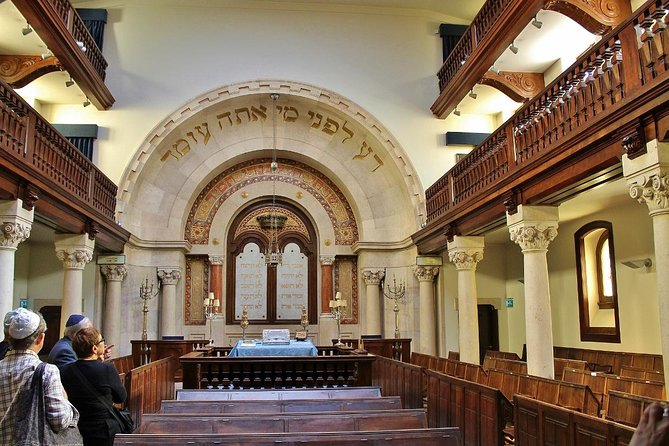
The experience begins at Shaare Tikva, at Rua Alexandre Herculano 59, north of Lisbon’s central squares. This is not just a meeting point. It is the strongest physical link to the city’s modern Jewish community and the part of the tour that most clearly fulfills the promise of a Jewish heritage visit.
Shaare Tikva was the first synagogue built in Portugal since the late fifteenth century. Inside, you receive an explanation of the synagogue, its members, and the place it holds within Lisbon’s Jewish community. A synagogue staff member may lead this portion before you continue with the city guide.
Allow about 45 minutes here. Admission is included, and the guide accompanies you inside rather than simply leaving you to look around on your own. That matters because the building’s significance is tied not only to its design, but also to the long interruption between the expulsion and persecution of Portuguese Jews and the reappearance of an organized synagogue community.
There is a dress code. You must avoid uncovered shoulders, shorts, and mini-skirts. You also need to provide passport details for every participant when booking, including name, number, expiry date, and country, because of synagogue security requirements.
The most important scheduling tip is simple: the inside visit is available only on Tuesdays and Thursdays. If your date falls on another day, confirm exactly what will be included before paying. The walking portion still has value, but entering Shaare Tikva is the clearest highlight.
More History Tours in Lisbon
- Lisbon: History, Stories and Lifestyle Walking Tour
★ 4.8 · 10,902 reviews - Lisbon: Live Fado Show with Port Wine in Historic Center
★ 4.7 · 4,166 reviews - Lisbon: Fado Show with Wine in a Historic Venue
★ 4.8 · 1,294 reviews
From Principe Real to Chiado
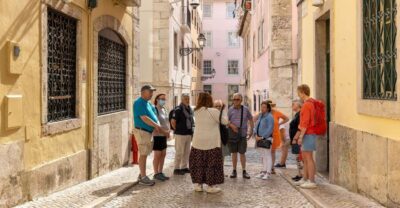
After the synagogue, the walk heads through Principe Real Park toward Chiado. This 30-minute stretch gives the guide room to place Lisbon’s Jewish story within the wider development of the city.
Do not expect a preserved medieval Jewish quarter on this part of the route. Lisbon’s older Jewish buildings were heavily affected by the earthquake, tsunami, and fires of 1755. Earlier destruction and transformation during the Portuguese Inquisition also removed or concealed Jewish symbols and locations.
That absence is central to the experience. You are often standing in a modern city while listening to an account of what occupied the same area centuries earlier. Without a guide, you would likely pass through these streets without realizing their connection to Jewish communities, forced conversions, religious persecution, or the later return of Jewish life.
This is also where you should judge the walking pace. The route crosses central Lisbon on foot, rather than moving between isolated attractions by vehicle. Wear sturdy shoes and bring water. The official advice calls for moderate physical fitness, and the walk can feel demanding if you are not comfortable with hills, steps, and several hours on your feet.
Bertrand Bookstore and a Jewish literary connection
In Chiado, the tour pauses at Bertrand, founded by Pedro Faure in 1732. It is recognized as the world’s oldest bookstore still operating, and the stop adds a literary thread to the historical story.
The guide explains a famous Jewish writer and points out a curiosity inside the bookstore. The supplied details do not identify the curiosity precisely, so the value here depends on the explanation you receive on the day. A later stop also brings in Fernando Pessoa, whose work and connection to Portuguese culture can become part of the conversation.
This portion is useful because the tour is not limited to synagogues and persecution. It considers how Jewish people and Jewish ideas connect with Portuguese writing, culture, and public life. Still, keep your expectations in check. Bertrand is an active bookstore, not a dedicated Jewish museum, and the Jewish connection is presented through the guide’s interpretation.
I like this kind of stop when a city has lost much of its original Jewish architecture. A bookshop, a writer, or a street name can help fill in gaps that stone buildings no longer can. It also gives you a short change of pace after the opening synagogue visit and before the longer route through Baixa.
Praça do Comércio and the turning points of Portugal
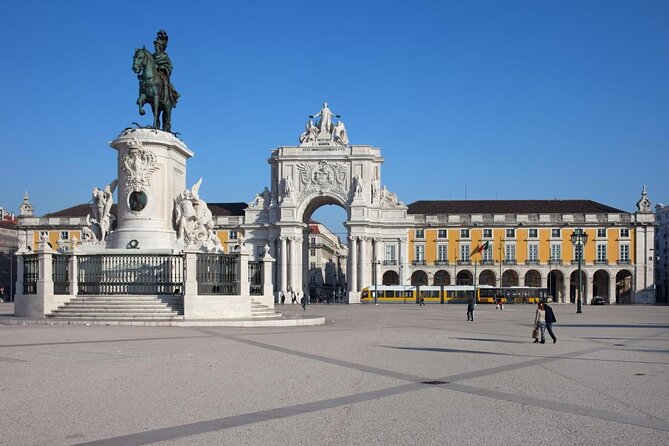
The walk continues into Baixa and reaches Praça do Comércio, also called Terreiro do Paço. This is Portugal’s largest square and one of Lisbon’s best places to understand the scale of the city’s political and commercial life.
The guide uses the square to explain several events that changed Portugal. The exact emphasis can vary, but the stop links national decisions with the experience of the Jewish population. That broader setting is important. Jewish life in Portugal was shaped not only by religious policy, but also by royal power, trade, migration, forced conversion, and the changing direction of the country.
There is no entrance fee at this stop. You spend about 30 minutes walking and listening in the open air, so timing and weather affect the experience. In rain or strong heat, the explanation may feel less comfortable than it would in mild weather.
This is one of the places where the tour’s strength and weakness meet. The square itself is a major Lisbon sight, but it is not a preserved Jewish site. You are learning how Jewish history fits into the city’s larger story rather than seeing a building that belonged to a Jewish family or congregation.
More heritage sites and old towns:
- Explore Lisbon by Tuk Tuk: History and Viewpoints
★ 5.0 · 840 reviews - Lisbon: Daytime or Sunset Boat Cruise with History and Wine
★ 4.9 · 819 reviews - Private Tuk Tuk Tour Through Lisbon’s Historical Streets
★ 5.0 · 734 reviews - Lisbon Sunset Sailing with Portuguese Wine and History
★ 5.0 · 668 reviews
Rossio Square and the old Inquisition center
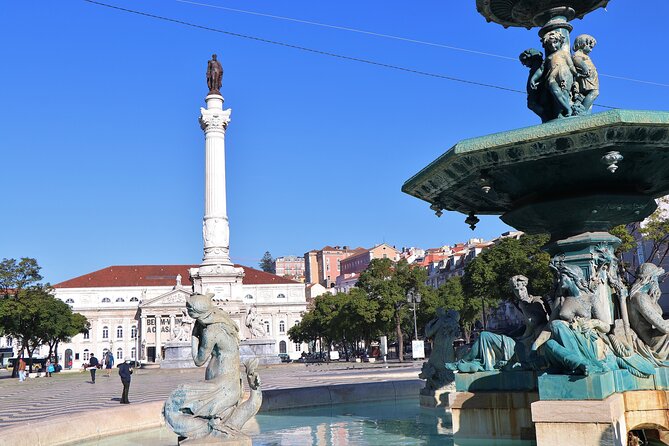
From Praça do Comércio, the walk heads toward Praça Dom Pedro IV, usually called Rossio. This section takes about an hour and carries the tour into one of its most difficult historical chapters.
At the center of Rossio is the Column of Pedro IV, known as the Soldier King. Four female figures at its base represent Justice, Wisdom, Strength, and Moderation. Nearby, the D. Maria II National Theatre occupies the former site of the Estaus Palace.
That former palace served as the headquarters of the Portuguese Inquisition from the mid-fifteenth century. The setting gives the guide a direct way to explain how religious control affected Portugal’s Jewish population and the people classified as New Christians after forced conversion.
You should give this part your full attention. It is less about visual remains and more about understanding the institutions that shaped daily life, identity, fear, and public behavior. The guide’s storytelling is doing much of the work because the palace itself is gone.
The tour’s strongest guides, particularly Paulo Levy, are praised for explaining these links in clear English and for answering questions patiently. Paulo’s personal connection to his Jewish roots adds feeling without changing the basic need for historical care. He is also known for discussing Portuguese history beyond Jewish subjects, which helps explain why events in Lisbon unfolded as they did.
Igreja de São Domingos and the 1506 massacre
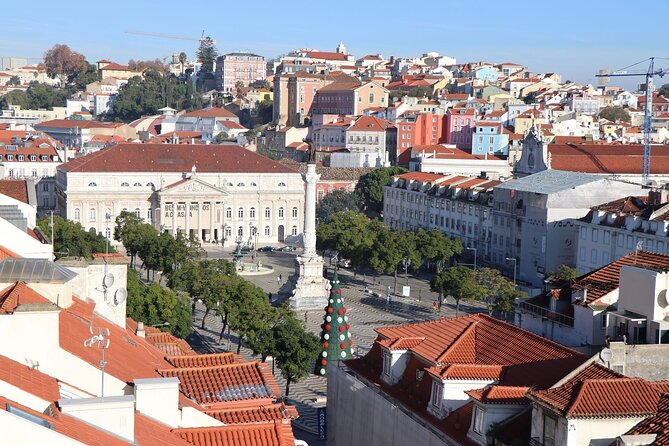
The final scheduled stop is Igreja de São Domingos, near Rossio. The church marks the center of the Lisbon Massacre that began on April 19, 1506.
The guide explains how more than 3,000 New Christians were murdered in the streets over three days before the king’s army stopped the violence. São Domingos was the epicenter of this tragedy, making it one of the most important places on the route even though the building is not presented as a surviving Jewish monument.
This can be an emotional stop. The setting looks like part of an ordinary central Lisbon walk, yet the story concerns public violence, religious hatred, and the destruction of families and community life. You may find the contrast unsettling, but it is precisely why a guide helps. The physical city does not announce what happened here.
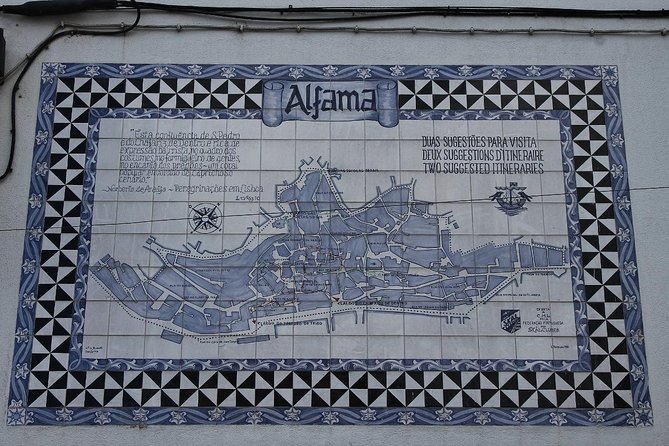
The stop is scheduled for about 30 minutes. Afterward, the route may end in Lisbon’s Old Town, sometimes identified as Alfama, but the exact endpoint is flexible. It can change according to the group’s questions, walking ability, and weather. Some tours may finish with a meal at an authentic Portuguese restaurant, but lunch is not included and should not be treated as part of the guaranteed program.
What the four hours feel like
The tour is advertised at about four hours, but the day has some flexibility. A change from morning to afternoon, for example, can make the schedule feel tight in winter when sunset comes earlier. If your booking time is altered, ask how that affects the synagogue visit and the walking route.
The group limit of eight is a real advantage. A small group makes it easier to hear explanations on busy streets, ask questions, and adjust the pace. It also suits a subject that benefits from conversation. Paulo’s style, based on the available feedback, is energetic and personal rather than scripted and distant.
At the same time, the small group does not remove the physical demands. One account describes walking about four miles, and another warns of a long route through narrow streets and many steps. If you have limited mobility or dislike extended city walks, ask in advance if the route can be shortened. The stated requirement is moderate physical fitness, so this is not a gentle sightseeing circuit.
The endpoint is deliberately loose. If the group still has questions, feels energetic, or wants to see more of the Old Town, the guide may continue. If the weather turns poor or the group is tired, the walk may end sooner in central Lisbon. That flexibility is friendly, but it also means you should not plan a tightly timed activity immediately afterward.
The value of $84.10
At $84.10 per person, this is not the cheapest way to see central Lisbon. The value comes from the combination of a small group, a professional guide, the synagogue interior, and several hours of interpretation that you would not get from simply walking through the same streets.
Entrance fees are included, and the tour is designed to avoid waiting in ticket lines. The synagogue admission is the key inclusion. The other stops are public squares, streets, a church exterior or historic setting, and a bookstore, so the price is not paying for a long list of paid attractions.
I would consider the cost fair if Jewish and Sephardic history is a major reason for your Lisbon visit, especially if you want context rather than only photographs. The price is harder to justify if you mainly want a general introduction to Lisbon’s central sights. Praça do Comércio, Rossio, Chiado, and Principe Real can all be visited independently.
The group discount may improve the value for companions booking together. Lunch is extra, and any restaurant stop at the end is optional rather than included. Budget for food separately.
Who will enjoy this walk most
I would recommend this experience to you if you want:
- A focused introduction to Jewish life in Portugal from the medieval period through the modern era
- A visit inside Lisbon’s Shaare Tikva Synagogue
- A guide who can connect Jewish history with Portuguese politics, literature, and culture
- A small group rather than a large city tour
- A personal account of Sephardic identity, especially from a guide such as Paulo Levy
- A walking route that combines difficult history with major Lisbon sights
It is also suitable for visitors of different faiths and backgrounds. You do not need to be Jewish to understand the material, and the tour also provides a useful introduction to Portuguese history more broadly.
I would hesitate if you want to see many intact Jewish buildings, a clearly marked old Jewish quarter, or a museum-style presentation with indoor exhibits. Lisbon simply does not retain many visible traces of its earlier Jewish communities. The tour asks you to imagine the lost places through explanation and context.
Practical advice for a better day
Book a Tuesday or Thursday if entering Shaare Tikva is important to you. Confirm the synagogue schedule before finalizing other plans, since the inside visit is limited to those days.
Dress respectfully for the synagogue. Covered shoulders and legs are the safest choice, and appropriate clothing avoids an awkward problem at the first stop.
Wear comfortable shoes with good grip. Lisbon’s central streets can be steep and uneven, and the route may include steps. Bring water, and consider rain protection because several stops take place outdoors.
Keep the afternoon open after the tour. The endpoint may shift within the Old Town, and the guide may adapt the finish based on the group. You may also want time for a Portuguese meal, though you pay for it yourself.
Finally, ask questions. This tour works best when you are curious about the missing buildings, the former Jewish neighborhoods, New Christian identity, Portuguese writers, and the guide’s own connection to the subject. The physical evidence is limited, so conversation is part of the experience rather than an extra.
Should you book Jewish Sephardic History in Lisbon?
Book it if you want the synagogue visit and a thoughtful explanation of Lisbon’s Jewish past, and if you are ready for a long city walk. The strongest part is the combination of Shaare Tikva and Paulo Levy’s passion, with the central Lisbon route showing how much history has disappeared beneath the modern city.
Do not book it expecting a preserved Jewish quarter or a series of Jewish monuments. Instead, think of the tour as a guided act of reconstruction. For the right audience, that makes the missing buildings meaningful rather than disappointing. Free cancellation is available up to 24 hours before the start time, giving you some flexibility if your plans change.
FAQ
How long does the Jewish Sephardic history tour last?
The tour lasts approximately four hours, including the synagogue visit and the walking route through central Lisbon.
Where does the tour start?
It starts at Shaare Tikva Synagogue, Rua Alexandre Herculano 59, 1250-010 Lisbon, Portugal.
Where does the tour end?
The stated endpoint is Alfama in Lisbon’s Old Town, but the exact finish may change. It depends on the group’s curiosity, physical capabilities, and weather conditions.
Can I visit inside the synagogue on any day?
No. The inside visit is available only on Tuesdays and Thursdays.
What is included in the price?
The price includes a small-group tour with a professional guide, entry to Shaare Tikva Synagogue, explanations inside the visited locations, and skipping ticket lines. Lunch and other unlisted expenses are not included.
How much walking is involved?
You should expect a substantial amount of walking. The route may cover about four miles and includes narrow streets and steps, so moderate physical fitness is recommended.
Just added around Lisbon
- Tuk tuk tour in Belem area★ 5.0 · 46 reviews
- Lisbon: Private Tour Sintra, Cabo da Roca and Cascais★ 4.9 · 46 reviews
- Private Sintra Tour from Lisbon★ 5.0 · 46 reviews
- Premium Porto Private Day Trip from Lisbon with Local Guide★ 5.0 · 47 reviews
- 4 Hours Tuktuk City Tour in Lisbon★ 5.0 · 47 reviews
- Small Group Pena Palace, Sintra, Regaleira and Cascais★ 5.0 · 47 reviews
- From Lisbon: Tour to Fátima, Batalha, Nazaré and Óbidos★ 4.6 · 47 reviews
- Private 4 hour Sintra Tour★ 5.0 · 47 reviews
Historical Tours, compared.
Historical Sites, Wine Experience, Lunch & Cruise
Read our review →
Live Fado Show with Port Wine in Historic Center
Read our review →


Browse the lists this tour appears in