
Reviewed · WALKING TOURS
Aveiro: Stories, Canals, and Azulejos Guided Walking Tour
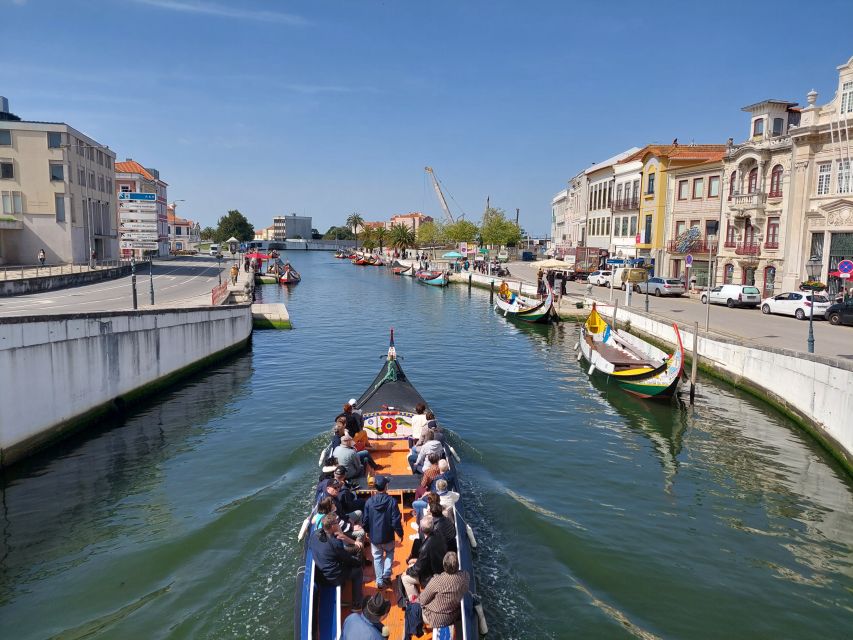
Aveiro rewards a slower look. This two-hour walking tour links its canals, tiled façades, churches, boats, and salt-making past into one clear story, so you see more than a pretty Portuguese postcard.
I like the focus on azulejos and local boats, details that are easy to miss when you explore alone. I also like the guide’s personal connection to Aveiro, especially when Antonio or Tony Walker leads the walk with humor and the ease of someone showing you his hometown. The main consideration is the pace and terrain: this is not a soft stroll for everyone, and it is unsuitable for wheelchair users, people with mobility limits, or those with a low level of fitness.
In This Review
- Key points to know before you book
- Why Aveiro makes a guided walk worthwhile
- Starting at Praça da República and the city center
- The Carmelite Convent Church on Praça Marques de Pombal
- Tile façades and the story of Princess Santa Joana
- Canal da Fonte Nova and Aveiro’s working waterways
- Beira Mar, Art Nouveau, and Art Deco details
- From medieval power to a difficult modern chapter
- Eel stew, ovos moles, and São Gonçalinho
- Guide style and the value of the storytelling
- Who should book this Aveiro walking tour?
- Should you book it?
- FAQ
- How long does the Aveiro walking tour last?
- Where does the tour start and finish?
- Which languages are available?
- Are entrance fees included?
- What should I bring?
- Is the tour suitable for children or people with mobility limitations?
Key points to know before you book
- The route covers Aveiro’s major historic quarters: Start at Praça da República, pass churches and the cathedral, continue through Beira Mar, and finish at São Gonçalinho.
- Azulejos are a major theme: You will look at tile panels, Art Nouveau façades, Art Deco details, and ironwork from the late 19th and early 20th centuries.
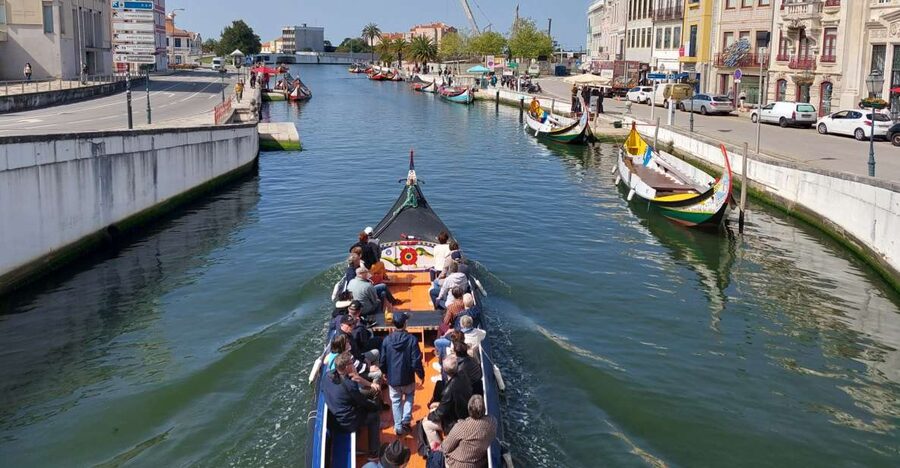
- The canals have a practical story: Learn how the waterways relate to the Ria de Aveiro and how moliceiros and mercanteis were used.
- The guide can make the difference: Antonio, also known as Tony Walker, is praised for clear explanations, warmth, humor, and his long connection with Aveiro.
- It is good value at $20: Nearly two hours of guided context costs little compared with the time you would spend trying to piece the city together alone.
- Plan for weather and walking: The tour runs rain or shine, and you should bring comfortable shoes, sunscreen, and suitable clothing.
Why Aveiro makes a guided walk worthwhile
Aveiro is often reduced to canals and colorful boats. That picture is not wrong, but it is incomplete. The city has churches filled with detail, grand tiled buildings, a salt-producing tradition, a former ceramics industry, and a past shaped by both success and hard times.
I find a guide particularly useful here because Aveiro’s stories are spread across ordinary-looking streets. A painted tile panel may be easy to pass without context. A canal may look decorative until you learn what it carried and why it mattered. A church façade can seem modest until someone explains its place in the city’s religious and civic life.
The walk also gives you a useful first orientation. You move from the central square toward the former convent district, then through the canal area and Beira Mar neighborhood before reaching the saltpans. That route connects the city center to the lagoon rather than treating the canals as an isolated attraction.
At $20 per person, the price is sensible if you want more than photographs. The included places are free entry or viewed from outside, so you are mainly paying for the guide’s interpretation. That is the right way to judge this experience: not as a ticket to monuments, but as a compact introduction to how Aveiro fits together.
More Walking Tours in Porto
- Porto Walking Tour, Lello Bookshop, River Cruise and Cable Car
★ 5.0 · 3,354 reviews - Experience Porto’s Charm: 3-Hour Guided Walking Tour
★ 5.0 · 2,432 reviews - Porto: 3-Hour Guided City Highlights Walking Tour
★ 4.8 · 2,050 reviews
Starting at Praça da República and the city center
Meet near the statue in the center of Praça da República. Your guide wears a yellow and blue badge, which makes the meeting point easier to identify in a busy central area.
The tour begins with Aveiro’s Town Hall and the Misericórdia Church. This is a strong opening because it places civic power and religious life side by side. Instead of rushing straight to the canals, you begin with the city’s formal center and get a sense of how public Aveiro presents itself.
From here, the route follows Rua de Coimbra. One early detail is the black and white calçada à portuguesa, the patterned paving used across Portugal. It is worth looking down now and then. The stones are not just practical ground cover; their shapes and contrasts form part of the visual language of Portuguese towns.
You should wear shoes with a firm sole. Calçada can be uneven, and the route continues for roughly two hours. The walking is manageable for many people who are comfortable on city streets, but the tour is not designed for anyone who needs step-free access or frequent assistance.
The Carmelite Convent Church on Praça Marques de Pombal
At Praça Marques de Pombal, the group enters the Carmelite Convent Church. This is one of the tour’s most rewarding stops because it is small enough to feel intimate but packed with baroque character.
A short visit here works better with explanation than without it. A guide can help you notice the decorative choices, religious imagery, and the way a compact church creates a sense of ceremony. The church is described as a small baroque jewel, but the useful point is not the label. It is the contrast between its modest scale and the amount of visual information inside.
The tour does not promise long museum visits or extended interior time at every stop. Some sites are walk-through visits, while others are appreciated from the street. If you prefer a tour built around lengthy monument admissions, this may feel light. If you want a guided framework with several carefully chosen glimpses, the format works well.
Tile façades and the story of Princess Santa Joana
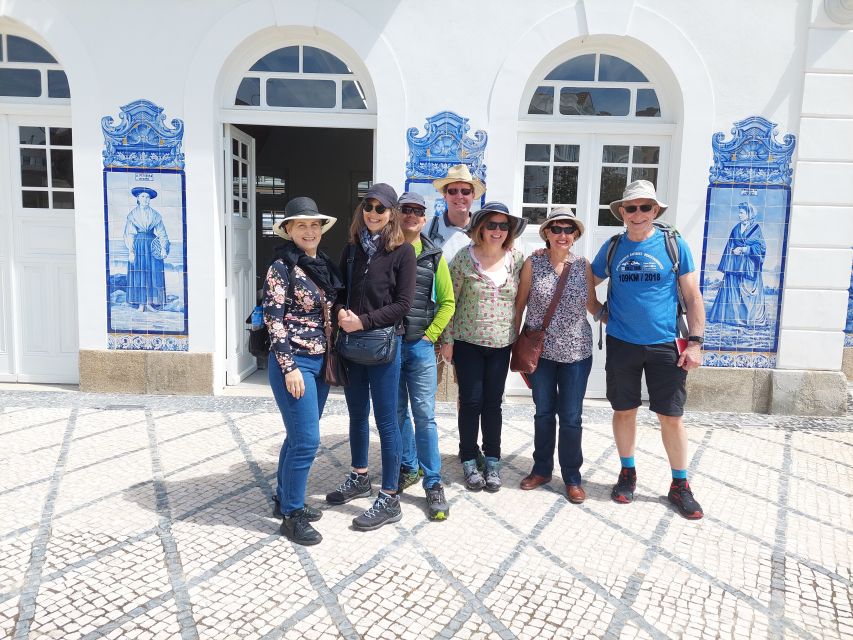
As you continue, the route brings you to tile panels at Casa de Santa Zita and Sapataria Leão. These façades help explain why Aveiro is so rewarding for anyone who pays attention to building fronts.
The azulejos range from early modern examples to later designs. You will look at how tiles decorate façades, communicate style, and give otherwise practical buildings a strong local identity. This is not only a lesson in decoration. Tiles tell you about changing taste, craft, commerce, and the way Portuguese cities use public architecture to make daily streets more distinctive.
The walk then passes the Dominican Convent of Jesus. Here, the guide tells the story of Princess Santa Joana, Aveiro’s patron saint. Her connection gives the city a personal historical figure rather than a list of dates. The story also connects the convent to Aveiro’s religious identity and helps explain why this site matters beyond its architecture.
After the convent, you pass the cathedral. The route keeps moving, so do not expect a full cathedral study. Instead, this part serves as a bridge between the older religious center and the canals that shaped Aveiro’s working life.
More guided walks:
- Porto: Wine Tasting with Tapas Walking Tour
★ 4.4 · 1,541 reviews - Porto: Historic City Center Walking Tour
★ 4.7 · 1,172 reviews - Porto’s #1 Walking Tour
★ 5.0 · 1,026 reviews - Porto: Delicious Food and Wine Walking Tour
★ 4.8 · 977 reviews
Canal da Fonte Nova and Aveiro’s working waterways
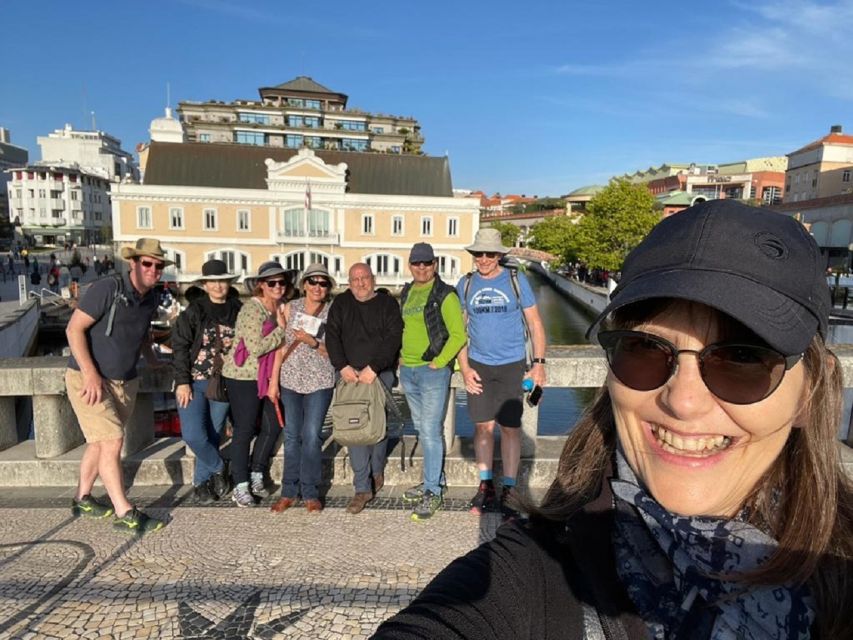
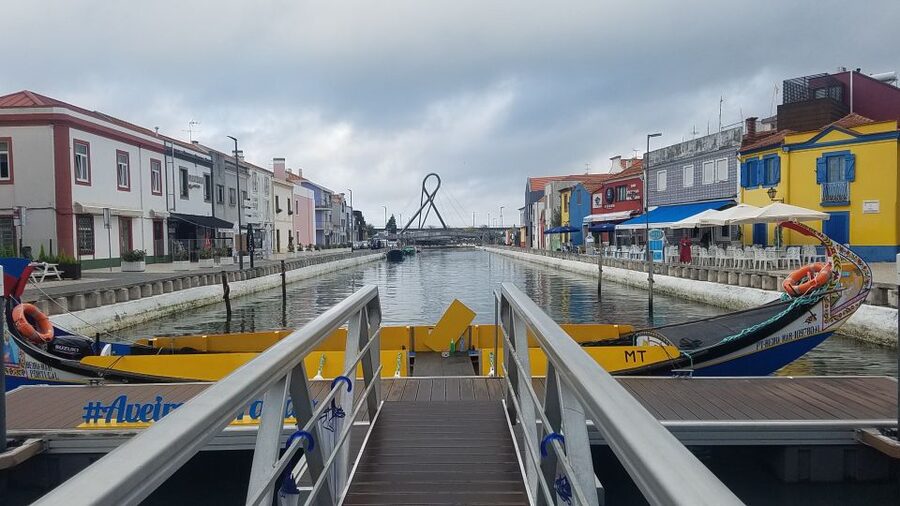
The Canal da Fonte Nova marks a change in the walk. Here you see the surviving building of one of the ceramics factories that once operated in the area.
That industrial detail adds welcome balance. Aveiro is not only churches, sweets, and decorative façades. Its canals supported work, movement, and production. The old factory building gives you a physical reminder of that past, even if you are not entering a museum or industrial site.
Along the canals, the guide explains their origin and practical use. You also learn to recognize the traditional boats of the Ria de Aveiro, including moliceiros and mercanteis. The names matter because these boats were not simply made for sightseeing. Their forms and uses belong to the lagoon’s working culture.
The lagoon’s salt is part of the sensory character of the city. The tour promises stories connected to the smell of the lagoon and saltpans, which gives the walk a more grounded feel than a purely architectural tour. You begin to understand Aveiro as a place shaped by water, salt, mud, boats, and industry.
One useful expectation: this is a walking tour, not a boat ride. If you want to travel on a moliceiro, that can be booked separately. One particularly practical assessment from the experience is that the walking tour may be the better first choice, with a boat trip added afterward if you want both.
Beira Mar, Art Nouveau, and Art Deco details
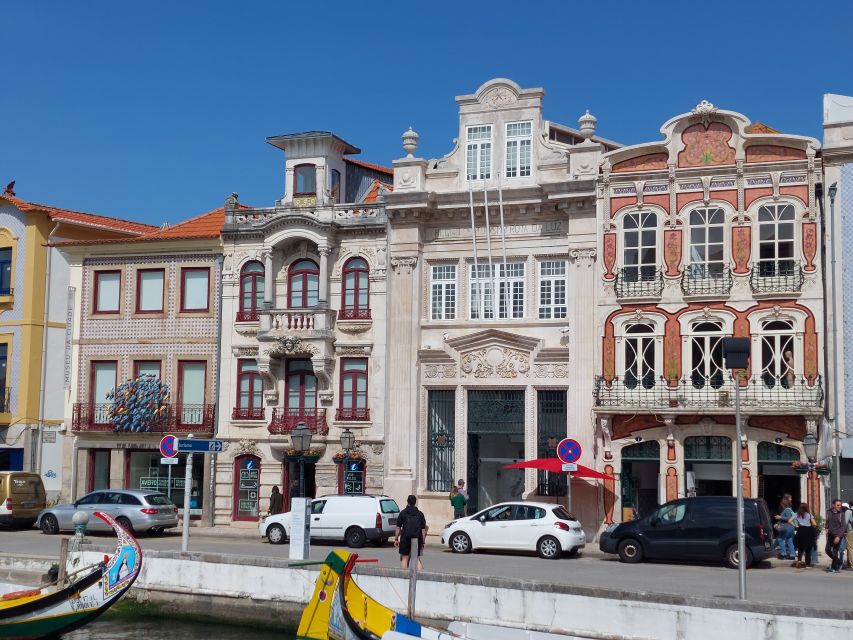
The route continues through the Beira Mar neighborhood, where tiled façades fill the streets. This is likely to be the most visually satisfying section for architecture fans because the details arrive at walking speed, not through a passing vehicle window.
You will look for Art Nouveau lines, Art Deco touches, and iron architecture from the turn of the 19th to the 20th century. These styles can blur together when you see them without guidance. The tour helps separate them and shows how Aveiro’s architecture changed as the city entered a more modern period.
The two façades of the Museum of Art Nouveau are an important stop. Even if you do not go inside, the exterior gives you a focused example of the design language discussed along the route. Look for the relationship between tile, lettering, ironwork, curves, and the shape of the façade.
This section rewards curiosity. You do not need a specialist interest in architecture. You only need to slow down long enough to notice how much work is above eye level and how many buildings combine useful commercial space with elaborate public decoration.
From medieval power to a difficult modern chapter
On the way toward the saltpans, the guide places Aveiro’s past in a longer timeline. You hear about the city’s influence from the 11th to the 15th centuries, its severe decline during the 17th and 18th centuries, and its revival in the 19th century.
That arc is one of the tour’s strongest ideas. Cities can look stable when you visit them for an afternoon, but Aveiro’s story includes prosperity, hardship, and recovery. The canals and salt are not isolated curiosities. They are tied to the city’s changing fortunes.
The phrase crossing of the desert describes the difficult period in Aveiro’s history. It gives the walk a needed dose of realism. You see a pleasant city today, yet the guide shows that its current character developed through setbacks as well as success.
Because Antonio has lived in Aveiro for more than 20 years and has worked as a teacher, he appears especially suited to this kind of storytelling. His style is described as clear, funny, and generous with questions. If you enjoy learning through conversation rather than listening to a memorized speech, that is a meaningful advantage.
The guide may also adapt the visit to local circumstances. On one occasion, museums were open because of a festival, and the route changed to make use of free entrance. That flexibility cannot be guaranteed, but it suggests a guide who pays attention to what is happening in town.
Eel stew, ovos moles, and São Gonçalinho
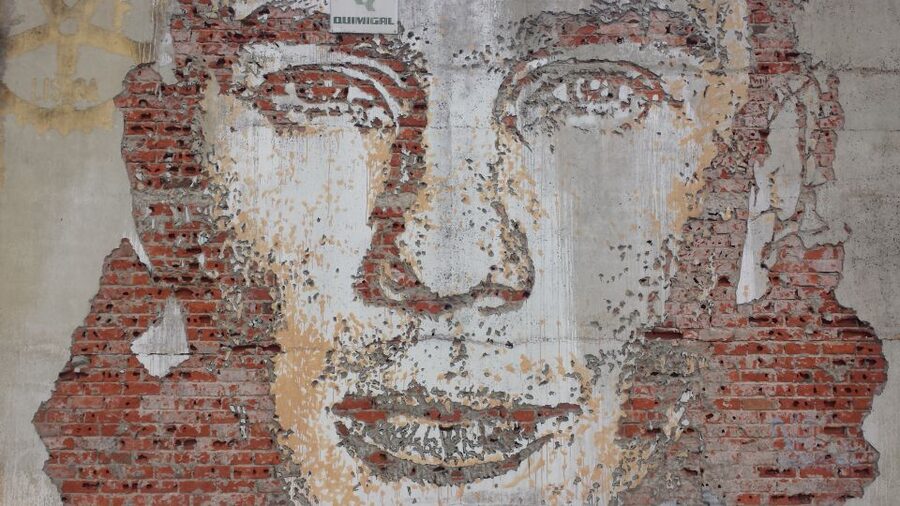
The return route brings in local food. You hear about eel stew, a dish connected to Aveiro’s waters, as well as ovos moles, the city’s famous sweet made with egg yolk and sugar.
Food references are brief rather than a tasting session, so bring your own snack or plan a separate stop if you want to try them during the day. Still, the culinary details help complete the picture. The same lagoon that shaped boats and salt also influenced what appeared in local kitchens.
The walk ends at the Church of São Gonçalinho. This is a lively finish, especially when the guide explains the January festival dedicated to the saint. During the celebration, a hard, heavy traditional sweet is thrown over the heads of the faithful in a joyful ritual.
That closing story captures the tone of Aveiro well. The city’s traditions are not confined to quiet churches or preserved façades. They can be playful, physical, and a little startling. Ending here gives the tour a human touch after the architecture and chronology.
The activity finishes back at the meeting point, so you are not left trying to find your way across town. That makes it easy to continue with lunch, a canal boat trip, or further independent sightseeing.
Guide style and the value of the storytelling
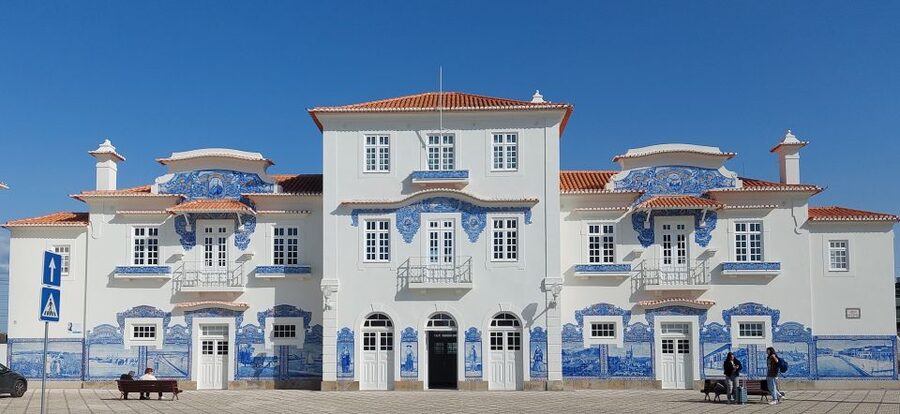
The guide is central to this experience. Antonio, also called Tony Walker, receives repeated praise for being warm, well-informed, funny, and attentive to questions. He has been described as a retired teacher and as someone who treats Aveiro like his hometown rather than a backdrop for a standard speech.
That personal style can change the entire walk. A city you found underwhelming on your own may look different once someone points out symbols, architectural details, and stories that are not obvious at street level. The strongest benefit is not simply factual information. It is learning what deserves your attention.
The tour is offered in Portuguese, French, English, and Spanish. Confirm your preferred language when booking. Group size is not provided, so you should not assume a private walk. In some circumstances the guide may have only a few people, but that depends on the date.
The two-hour length is well judged. It gives enough time to cover several districts without turning the afternoon into a march. Still, if the guide spends extra time answering questions or adapting to open sites, the walk can run longer. That is a plus for curious people, but those with a tight train or lunch reservation should leave a buffer.
Who should book this Aveiro walking tour?
I would choose this for a first visit to Aveiro, especially if you want to understand the city before taking a canal boat. It suits people who enjoy churches, tiled buildings, local history, traditional boats, and small architectural details.
It is also a good match for independent sightseers who already like walking alone but want a stronger explanation of what they are seeing. You may find that the city feels more interesting after the tour because you know where to look.
I would be cautious if you dislike uneven paving, cannot walk steadily for two hours, or need a wheelchair or baby carriage. Large bags, bicycles, alcohol, and drugs are not allowed, and unaccompanied minors and children under 10 are not accepted. Pregnant people are also listed as unsuitable for this activity.
Bring identification, comfortable shoes, sunscreen, and weather-appropriate clothing. The tour runs rain or shine, so do not plan on perfect conditions. Food and drinks are not included.
Should you book it?
Book this tour if you want Aveiro explained rather than merely photographed. For $20, you get a compact route through the city’s churches, canals, tilework, industrial traces, salt tradition, and food culture, with the chance to ask questions along the way.
I would especially recommend it if Antonio or Tony Walker is leading. His teaching background, local ties, humor, and willingness to explain details are repeatedly emphasized, and those qualities fit this city unusually well.
Skip it if you want a boat-only outing, a museum-heavy visit, or an easy accessible route. Otherwise, this is a smart first activity in Aveiro. Take the walk early in your stay, then decide if you want to add a separate moliceiro trip once the canals and their working past make more sense.
FAQ
How long does the Aveiro walking tour last?
The tour lasts two hours. Starting times vary, so check availability when booking.
Where does the tour start and finish?
It starts near the statue in the center of Praça da República. The guide wears a yellow and blue badge. The activity finishes back at the meeting point.
Which languages are available?
The live guide can conduct the tour in Portuguese, French, English, or Spanish.
Are entrance fees included?
All sites are either free entry or viewed as walk-through stops. Food and drinks are not included.
What should I bring?
Bring a passport or ID card, comfortable shoes, sunscreen, and clothing suitable for the weather. The tour operates rain or shine.
Is the tour suitable for children or people with mobility limitations?
Children under 10 are not accepted. The tour is also not suitable for pregnant people, wheelchair users, people with mobility impairments, or people with a low level of fitness. Baby carriages are not allowed.
Just added around Porto
- From Arouca: Paiva River Canoe Rafting Adventure Tour★ 5.0 · 46 reviews
- Jewish Walking Tour of Porto★ 4.5 · 46 reviews
- Porto Private Gourmet Food & Wine Historic Tour with a Sommelière★ 5.0 · 46 reviews
- Santiago and Valença do Minho Full Day Private Tour★ 5.0 · 47 reviews
- Porto: Aveiro with cruise, Costa Nova, Capelha do Senhor da Pedra★ 4.5 · 47 reviews
- Best of Porto Guided Tour: Cruise & Wine Tasting★ 4.5 · 47 reviews
- Water Canyoning★ 5.0 · 47 reviews
- Cruise Shore Excursion – Private Tuk Tuk Tour to the Historic Center★ 4.5 · 47 reviews
Walking Tours, compared.
Best of Lisbon Small-Group Guided Walking Tour
Read our review →
Porto Walking Tour, Lello Bookshop, River Cruise and Cable Car
Read our review →
Best of Lisbon Walking Tour: Rossio, Chiado & Alfama
Read our review →
Experience Porto’s Charm: 3-Hour Guided Walking Tour
Read our review →
Enjoy a Guided Levada Walk in the Rabaçal Valley
Read our review →Browse the lists this tour appears in