
Reviewed · WALKING TOURS
Lisbon Downtown & Alfama with a guide Walking tour
Lisbon rewards curious walkers. This low-cost guided route links Praça do Comércio, Baixa, and Alfama, giving you a useful first look at the city’s old core for just $3. I like the mix of grand squares and narrow medieval lanes, and I like that groups are capped at 20 people. The main catch is a serious one: the description calls this a full-day outing, but the stated duration is about two hours.
I also like the chance to hear local stories from guides such as Bruno, Mariana, Mihaela, Miguel, Ines, and Daniel, who have been praised for friendly, lively presentations. You should expect plenty of walking, hills, uneven streets, and mostly outdoor sightseeing. Bring water and proper shoes, and confirm the exact route before you set out.
In This Review
- Key points at a glance
- Why this $3 walk can be useful
- Starting beneath the Augusta Street Arch
- Praça do Comércio and the earthquake that changed Lisbon
- From Baixa and Chiado toward Alfama
- Alfama, Lisbon’s oldest-feeling quarter
- Churches, walls, and the National Pantheon
- Lisbon Cathedral and the Door of the Sea
- Feira da Ladra and a taste of daily Lisbon
- A route made for views and first-day orientation
- What the guides do best
- The important confusion about duration
- Who should book this walk?
- Should you book the Lisbon Downtown and Alfama walk?
- FAQ
- How long does the tour last?
- Where does the tour begin?
- Where does the tour finish?
- What departure times are available?
- What languages are available?
- Is food included?
- Is hotel pickup included?
- How large is the group?
- What should I bring?
Key points at a glance
- A $3 introduction to central Lisbon: The price is unusually low for a guided walk through several major districts.
- Praça do Comércio sets the historical stage: This huge Tagus-side square explains how the 1755 earthquake reshaped Lisbon.
- Alfama is the heart of the route: Medieval alleys, old walls, viewpoints, the cathedral, and Fado culture give the walk its strongest sense of place.
- A group of up to 20 keeps the walk manageable: That is small enough for questions, though not an intimate private tour.
- The route ends at Rossio Square: You finish in a useful central location near transport and more places to eat and explore.
- Check the duration carefully: The supplied details say approximately two hours, while other descriptions refer to a full-day tour with transport and additional sights.
Why this $3 walk can be useful
At $3, this experience is best viewed as an orientation walk rather than a deep visit to every attraction. You are paying for a guide, a planned route, and context that helps the streets make sense. That can be good value on your first morning in Lisbon, especially if you want help deciding which places deserve a later, longer visit.
The route begins on Rua dos Douradores and finishes at Rossio Square. That path takes you through the central districts of Baixa and Chiado before reaching Alfama, so you get a quick change of scenery: formal earthquake-era streets give way to steep lanes, old churches, tiled façades, and open viewpoints.
The guide is the key part of the experience. Bruno has been praised for explaining Portuguese history while pointing out small details in Lisbon’s narrow streets. Mariana adjusted the walking speed for a slower member of her group and even played Fado on her phone. Mihaela was praised for humor, local suggestions, and helping with food ideas. Those details matter because a good walking guide does more than name monuments. The guide helps you notice how the city works.
Still, you should not confuse a $3 walk with a private tour or a ticketed sightseeing package. The maximum group size is 20, and food, drinks, personal costs, gratuities, and transport back to your hotel are not included.
More Walking Tours in Lisbon
- Lisbon: History, Stories and Lifestyle Walking Tour
★ 4.8 · 10,902 reviews - Best of Lisbon Small-Group Guided Walking Tour
★ 5.0 · 4,869 reviews - Lisbon: Food and Wine Small Group Walking Tour
★ 4.9 · 4,082 reviews
Starting beneath the Augusta Street Arch
The walk begins near Rua dos Douradores, in Lisbon’s central Baixa district. One of the early landmarks is the Augusta Street Arch, the grand gateway from Praça do Comércio toward Rua Augusta.
The arch carries symbols tied to Portugal’s past and cultural figures. It is also sometimes read as an allusion to the entrance of Solomon’s Temple, which gives the monument an extra layer of meaning beyond its decorative stonework. Your guide can help turn a quick photo stop into a short lesson in how Portugal presented its power and identity.
Rua Augusta leads toward Praça do Comércio, one of Lisbon’s most impressive public spaces. The square opens toward the Tagus on its southern side, giving it a broad, airy feel after the tighter streets around it.
Praça do Comércio and the earthquake that changed Lisbon
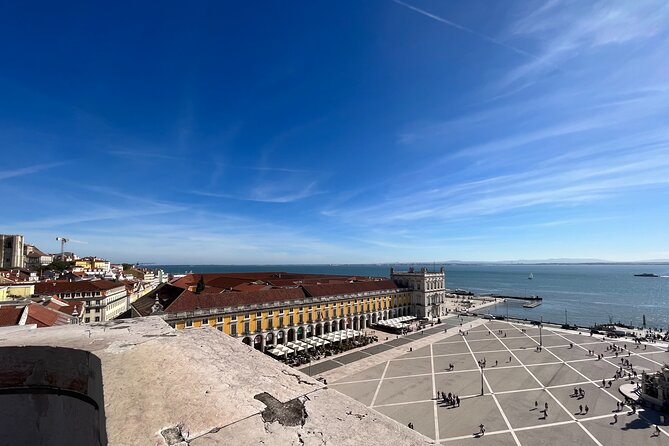
Allow about 30 minutes around Praça do Comércio. The square was once known as Terreiro do Paço because the royal Paço da Ribeira occupied this waterfront site until the earthquake of 1755 destroyed it.
The rebuilding that followed created much of the ordered Baixa you see today. Under the direction of the Marquis of Pombal, the city was reconstructed with a more regular street plan. This is one of the most useful stops on the route because it gives you a simple way to read the center of Lisbon. The straight streets and uniform blocks are not accidental. They belong to a deliberate rebuilding project.
The square later became home to important state departments. Look toward the river, then back through the arch toward Baixa. You can see why this was chosen as a ceremonial and political center.
The stop is free, but it is not a museum visit. The value comes from the guide’s explanation and the setting itself. If your guide moves quickly, take a moment to study the arch, the yellow façades, and the relationship between the square and the river.
From Baixa and Chiado toward Alfama
The route passes through Baixa and Chiado, two central areas with very different characters. Baixa is the more orderly district, shaped by the post-earthquake plan. Chiado is associated with shops, cafés, literary connections, and elegant city streets.
The walk may also include a building dating from 1521 that now houses the José Saramago Foundation. Saramago was Portugal’s only Nobel Prize winner in Literature, so this stop connects Lisbon’s old architecture with its modern cultural life.
You may hear about the Fado Museum as the route heads toward Alfama. The museum preserves the tradition of Fado, the Portuguese guitar-led music style closely associated with Lisbon. The information provided does not clearly state that the museum admission is included, so treat it as a sight or explanation along the way unless your guide confirms entry.
This distinction is important. A passing stop can be worthwhile, but it is not the same as time inside an attraction. If the museum matters to you, ask at the start how much time is planned there.
More guided walks:
- Best of Lisbon Walking Tour: Rossio, Chiado & Alfama
★ 4.9 · 2,700 reviews - Age of Discoveries Walking Tour in Belém
★ 5.0 · 1,513 reviews - Sintra & Cascais Day Tour with Pena Palace Entry and Gardens Walk
★ 5.0 · 962 reviews - Lisbon Roots – Small group Food & Culture Walking Tour w/tastings
★ 5.0 · 910 reviews
Alfama, Lisbon’s oldest-feeling quarter
The route’s strongest section is Alfama. Plan on about 20 minutes for the named Alfama stop, though the surrounding walk may take longer depending on the guide and the group’s pace.
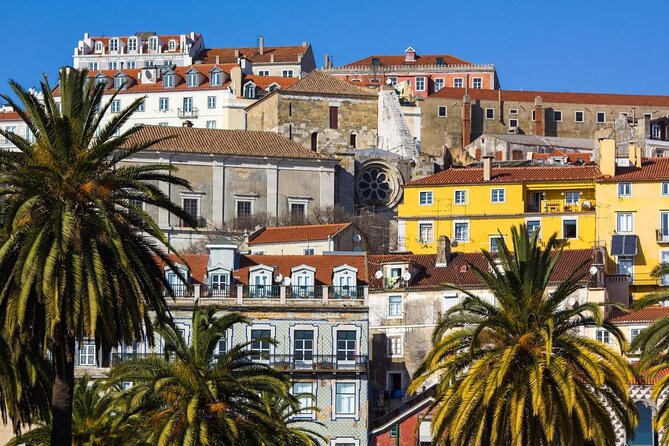
Alfama survived the 1755 earthquake in large part because it was built on dense bedrock. Its lanes feel older and less regular than Baixa’s streets. You will pass through narrow alleys and residential corners where the city’s past is not locked behind a ticket booth. This is the section where sturdy shoes matter most.
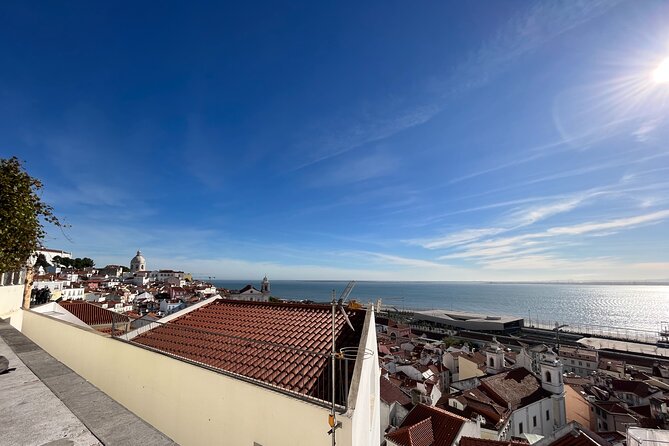
Alfama is also a fine place for photographs. The route includes viewpoints from old sections of the Cerca Moura, the former Moorish city wall. From these elevated spots, you can look across key Lisbon landmarks and understand the city’s steep relationship with the river.
The walk can be physically demanding. Lisbon’s center is full of slopes, stairs, polished paving, and uneven surfaces. One person described the city’s central sights as uphill, which is a fair warning. Even a short route can feel longer in warm weather or after a full day of sightseeing.
Churches, walls, and the National Pantheon
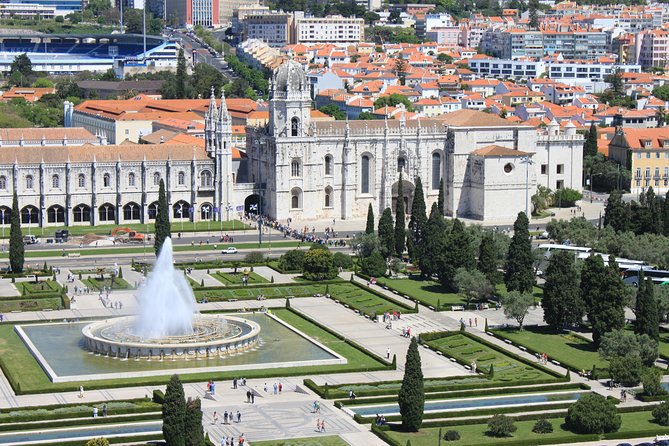
Several notable religious buildings appear among the Alfama stops. The National Pantheon occupies a church-like building that took more than 280 years to complete. It is the resting place of many Portuguese heroes and is one of the quarter’s major landmarks.
The route also includes a viewpoint by a church originally built by the Knights of the Order of Malta in the 12th century. Another church marks the reported birthplace of Saint Anthony of Lisbon, the patron saint of newlyweds and marriage vows. A local tradition says that single women can toss a coin toward the saint’s statue in hope of marrying within a year.
These stops show how much religious life shaped Lisbon’s streets. The details are also good conversation starters, particularly if your guide explains which traditions remain active and which are mainly local folklore.
A monastery is included among the points of interest as well. It influenced later church building in Portugal and continued in use until religious orders were abolished in the early 19th century. The supplied details do not promise interior admission at each church, monastery, or the National Pantheon. Ask before assuming that entrance fees or extended visits are part of the walk.
Lisbon Cathedral and the Door of the Sea
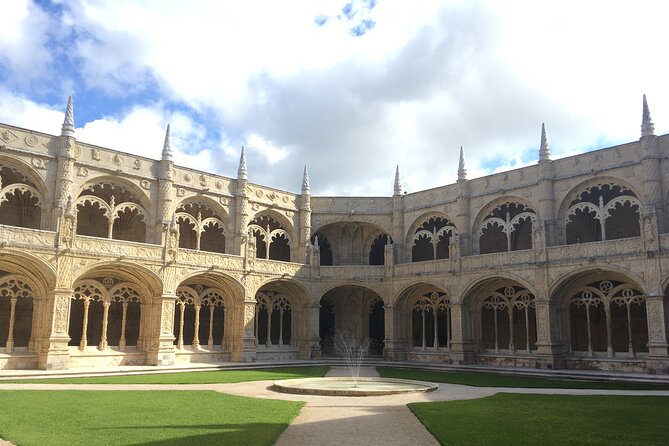
Lisbon Cathedral, commissioned by King Afonso I in 1150, was built where a mosque had once stood. The cathedral has suffered collapses and repeated rebuilding, so its appearance reflects several architectural periods rather than one neat style.
That makes it a useful stop for understanding Lisbon’s layered past. Roman, Moorish, medieval Christian, and later Portuguese influences overlap here. You can also see how the cathedral sits in relation to the steep streets of Alfama and the route toward São Jorge Castle.
Another stop is a former city entrance known as the Door of the Sea. Its name comes from its position near the beach and harbor when Lisbon was fortified. This is the kind of small historical detail that can be easy to miss when walking alone. The structure may not take long to see, but its name explains how the city once met the water.
Feira da Ladra and a taste of daily Lisbon

If the walk runs on Tuesday or Saturday, it may include Feira da Ladra, Lisbon’s traditional open-air flea market in and around Campo de Santa Clara. The market is held for locals and tourists, and its presence adds a more everyday note to a route otherwise filled with monuments.
Do not expect a formal market tour with guaranteed purchases or tastings. It is better to treat this as a chance to see a working Lisbon market and browse at your own pace if time allows.
The route also points out a family-owned grocery shop specializing in canned fish. Portugal takes its preserved seafood seriously, and a stop like this can be more useful than another quick monument photo. You may want to return later to buy a small food gift, but personal purchases are not included.
A route made for views and first-day orientation
The walk is especially useful if you want to get your bearings fast. You begin in the flat, formal center, move through Baixa and Chiado, then climb into Alfama and finish at Rossio Square. That sequence gives you a practical mental map of central Lisbon.
Rossio is a good ending point. From there, you can continue on foot, use nearby public transport, find a restaurant, or return to a hotel in the central area. Since hotel pickup and drop-off are not included, this central finish is more useful than an isolated endpoint.
The five self-guided walking tours in the Vox City app add value after the guide-led walk. The included audio commentary is available in English, French, Italian, Spanish, Chinese, and German. You need your own mobile device, since the device itself is not supplied.
What the guides do best
The strongest praise goes to the individual guides. Bruno was singled out for making history lively and adding small touches throughout the route. Mariana adapted her speed to suit the group and used Fado to bring the music tradition to life. Miguel, Ines, Daniel, and Mihaela were also praised for clear explanations, warmth, and useful suggestions.
That pattern tells you what to hope for, but guide quality can vary from one departure to another. The route has enough strong sights to work well even with a basic presentation, yet an engaging guide will make the old lanes and church façades far more memorable.
A group of 20 is a reasonable compromise. You should have a better chance of hearing the guide than in a very large city tour, but you may still need to stay close in busy streets. If you have questions, ask them early rather than waiting until the group is spread across a lane.
The important confusion about duration
The supplied details contain a mismatch that you should not ignore. The tour is described as lasting approximately two hours, with departure choices at 9:45 and 13:45. The route begins on Rua dos Douradores and ends at Rossio Square.
At the same time, other descriptions connected with this experience refer to a full-day Lisbon tour with a vehicle, Belem, the Jerónimos Monastery, the Water Museum, a lunch stop, a custard tart, and other sights. Some comments also describe hotel pickup, a driver, and a mixture of riding and walking.
Those details do not fit neatly with a two-hour downtown and Alfama walk. Do not book expecting Belem, lunch, hotel pickup, or a van unless the operator confirms that you are reserving that specific version. Contact the company at least 24 hours before the activity to confirm that it will run and to clarify the exact schedule, especially if weather is poor.
Who should book this walk?
I would recommend it to a first-time visitor who wants a quick introduction to central Lisbon, likes learning from a local guide, and is comfortable walking uphill. It also suits people on a tight budget, since $3 buys a planned route and live commentary for less than the cost of many short city activities.
It is a good choice if you want to return later to the National Pantheon, Fado Museum, cathedral, market, or viewpoints with more time. The walk helps you decide which places deserve a second visit.
I would be cautious if you have limited mobility, dislike steep streets, or need guaranteed interior access to specific monuments. I would also avoid booking it without clarification if you are expecting a full-day vehicle tour. Wear tennis shoes or similar footwear, carry water, use sunscreen in summer, and bring a jacket in winter. The tour normally proceeds in adverse weather unless official warnings or alerts require cancellation.
Free cancellation is available up to 24 hours before the start time. Within 24 hours, the payment is not refunded, and the activity also requires a minimum number of participants.
Should you book the Lisbon Downtown and Alfama walk?
Book it if you want a very inexpensive, guide-led introduction to Lisbon’s central quarters and are happy with a brisk outdoor route. The Alfama lanes, cathedral, old wall viewpoints, Praça do Comércio, and Rossio finish give you plenty of useful context for later exploring.
Do not book it on the assumption that $3 includes a full day, meals, transport, or entry to every attraction. Confirm the duration and exact itinerary first. With that question settled, this is a practical little walk, and the right guide can turn two hours among Lisbon’s hills into a strong start to your visit.
FAQ
How long does the tour last?
The stated duration is approximately two hours. Other details describe a full-day version, so confirm the schedule and route before booking.
Where does the tour begin?
The meeting point is Rua dos Douradores, number 16, in Lisbon.
Where does the tour finish?
The walk ends at Rossio Square.
What departure times are available?
The listed meeting times are 9:45 and 13:45.
What languages are available?
English, Spanish, and Portuguese are available year-round. The Vox City app also offers audio commentary in English, French, Italian, Spanish, Chinese, and German.
Is food included?
No. Food and drinks are not included unless specifically stated for the version you book.
Is hotel pickup included?
No. Hotel pickup and hotel drop-off are not included.
How large is the group?
The maximum group size is 20 people.
What should I bring?
Wear tennis shoes or other suitable footwear and bring water. Sunscreen is useful in summer, while a jacket is important in winter.
Just added around Lisbon
- Tuk tuk tour in Belem area★ 5.0 · 46 reviews
- Lisbon: Private Tour Sintra, Cabo da Roca and Cascais★ 4.9 · 46 reviews
- Private Sintra Tour from Lisbon★ 5.0 · 46 reviews
- Premium Porto Private Day Trip from Lisbon with Local Guide★ 5.0 · 47 reviews
- 4 Hours Tuktuk City Tour in Lisbon★ 5.0 · 47 reviews
- Small Group Pena Palace, Sintra, Regaleira and Cascais★ 5.0 · 47 reviews
- From Lisbon: Tour to Fátima, Batalha, Nazaré and Óbidos★ 4.6 · 47 reviews
- Private 4 hour Sintra Tour★ 5.0 · 47 reviews
Walking Tours, compared.
Best of Lisbon Small-Group Guided Walking Tour
Read our review →
Porto Walking Tour, Lello Bookshop, River Cruise and Cable Car
Read our review →

Best of Lisbon Walking Tour: Rossio, Chiado & Alfama
Read our review →
Experience Porto’s Charm: 3-Hour Guided Walking Tour
Read our review →
Enjoy a Guided Levada Walk in the Rabaçal Valley
Read our review →Browse the lists this tour appears in