
Reviewed · CITY TOURS
Lisbon Walking Tour – The Perfect Introduction to the City
Lisbon reveals itself one story at a time. This two-and-a-half-hour walking tour links the city’s main downtown sights with clear explanations of its earthquake, monarchy, religious conflicts, and Carnation Revolution. I like the route because it gives you a useful mental map of Baixa, Chiado, Rossio, and Bairro Alto before you start exploring alone. I also like the practical advice, especially the restaurant, viewpoint, and public transportation suggestions shared by guides such as Tiago, José, Natalia, and Walter.
The main consideration is the tip-based price. The booking cost is listed as only $1.25 per person, but this is a pay-what-you-feel tour, so you should plan to pay the guide at the end. One guide reportedly asked for a minimum of €10 per person, which left one participant uncomfortable. Also, a few people found a guide spoke too quickly, so your experience may depend on the particular guide assigned that day.
In This Review
- Key things to know before you go
- Starting beneath the Rua Augusta Arch
- Praça do Comércio and the earthquake that reshaped Lisbon
- From the city hall to the Santa Justa Elevator
- Rossio, Rua Augusta, and a difficult chapter of Lisbon’s past
- Avenida da Liberdade and Casa do Alentejo
- Largo do Carmo and the Carnation Revolution
- Rossio Station and São Roque Church
- Camões Square and the edge of Bairro Alto
- How the guide affects the experience
- What the $1.25 price really means
- Rain, mobility, and booking details
- Who should book this Lisbon walking tour?
- Final verdict: a smart first walk through Lisbon
- FAQ
- Where does the Lisbon walking tour begin?
- Where does the tour end?
- How long does the tour last?
- What language is the tour offered in?
- What is included in the $1.25 price?
- Is a tip expected?
- What landmarks are visited?
- Is the tour suitable for most people?
- Can the tour operate in the rain?
- How many people can join the tour?
- Can I cancel the tour?
Key things to know before you go
- The orange umbrella makes the meeting point easier to find: Meet at Praça do Comércio, between the large arch and the statue of King José I.
- You walk from the riverfront to Camões Square: The route passes through Baixa, Rossio, Chiado, and Bairro Alto.
- The 1755 earthquake is a major theme: You will learn how the disaster changed Lisbon’s streets, buildings, and civic identity.
- The guides add useful local advice: Restaurant suggestions, shortcuts, viewpoints, and transportation tips are part of the appeal.
- The group can include up to 20 people: That is small enough for a personal feel, though a full group can be harder to hear.
- Rain does not automatically stop the tour: Bring an umbrella or rain poncho and wear comfortable shoes.
Starting beneath the Rua Augusta Arch
The tour begins at Praça do Comércio, Lisbon’s grand riverfront square. Look for the guide carrying an orange umbrella, positioned between the triumphal arch and the statue of Dom José I in the center of the plaza.
This is a smart starting point. The square was rebuilt after the Great Lisbon Earthquake of 1755, and its broad, orderly design gives you an immediate clue about the city’s past. Before the earthquake, this area had a different form and function. After the disaster, Lisbon was rebuilt with straighter streets and a more controlled urban plan.
The statue of King José I provides a natural introduction to Portugal’s monarchy and the political forces behind the rebuilding of Lisbon. You can expect roughly 15 minutes here, including the initial welcome and explanation of how the free walking tour works.
That explanation matters. The low booking price is not the full cost of the experience in the usual sense. You pay the guide at the end according to your judgment, although you should be prepared for the guide to explain that tips are how the tour operates. If you dislike uncertain pricing, a fixed-price tour may suit you better.
More Walking Tours in Lisbon
- Lisbon: History, Stories and Lifestyle Walking Tour
★ 4.8 · 10,902 reviews - Best of Lisbon Small-Group Guided Walking Tour
★ 5.0 · 4,869 reviews - Lisbon: Food and Wine Small Group Walking Tour
★ 4.9 · 4,082 reviews
Praça do Comércio and the earthquake that reshaped Lisbon
The group then spends time in Praça do Comércio, officially one of the largest squares in Lisbon. Its open space faces the Tagus River, and the scale can make the city feel more theatrical than it does in the narrow streets nearby.
The earthquake story gives this part of the walk real purpose. Guides explain the destruction caused by the 1755 earthquake and how Lisbon responded afterward. The subject is not treated as a distant date to memorize. It helps you understand why the lower city looks so different from older parts of Lisbon and why some historic buildings survived while others disappeared.
The tour does not take you through a museum, so this is mainly an outdoor history lesson. On a hot or rainy day, you will want water and weather protection. The walk continues through exposed public spaces before moving into denser streets.
From the city hall to the Santa Justa Elevator
A short stop at Municipal Square introduces Lisbon’s city hall and civic center. It is only about five minutes, but it helps connect the city’s grand public spaces with its everyday government.
Next comes the Santa Justa Elevator, one of Lisbon’s most recognizable landmarks. The guide explains its place in the city rather than simply pausing for a photograph. The iron structure rises dramatically between Baixa and the higher streets of Chiado, and its location shows how Lisbon’s steep terrain has shaped transport and daily life.
The stop itself is brief, around five minutes. Do not expect to ride the elevator as part of this experience. The itinerary gives you access to the walking tour, not a separate attraction ticket. If you want to ride Santa Justa later, you will need to arrange that separately.
Carmo Church and its ruins receive more attention later, at Largo do Carmo. That division works well because you first see the elevator as an engineering landmark, then connect it with the earthquake and the surviving church ruins.
Rossio, Rua Augusta, and a difficult chapter of Lisbon’s past
Praça Dom Pedro IV, commonly called Rossio, is described as Lisbon’s oldest square on the route. It is one of the city’s key meeting points, with a broad pedestrian area and a long connection to public life.
The guide uses the square to explain Lisbon’s history and culture, then the group moves along Rua Augusta. This is the main pedestrian street through Baixa, running toward Praça do Comércio. It is an easy place to get your bearings because it forms a clear axis through the lower city.
The next stop is more solemn. The memorial to the victims of the 1506 Jewish massacre honors the thousands of Jewish people killed during a period of religious violence. This is an important inclusion because it moves the tour beyond palaces, viewpoints, and attractive streets. Lisbon’s past includes painful episodes, and the memorial gives the guide a chance to discuss persecution and the treatment of religious minorities.
At Igreja de São Domingos, the subject remains serious but becomes architectural. The church is known for its dramatic interior and survival through major disasters, including the 1755 earthquake. Allow about 10 minutes here. The guide’s storytelling is especially useful at places like this, where the exterior alone cannot explain why the building matters.
Some people describe the tour guides as animated and passionate when discussing the earthquake, the church, and the city’s political history. Tiago is often praised for his storytelling and enthusiasm, while José is noted for combining humor with clear explanations. The tone should be lively, but remember that speaking speed can vary.
More guided walks:
- Best of Lisbon Walking Tour: Rossio, Chiado & Alfama
★ 4.9 · 2,700 reviews - Age of Discoveries Walking Tour in Belém
★ 5.0 · 1,513 reviews - Sintra & Cascais Day Tour with Pena Palace Entry and Gardens Walk
★ 5.0 · 962 reviews - Lisbon Roots – Small group Food & Culture Walking Tour w/tastings
★ 5.0 · 910 reviews
Avenida da Liberdade and Casa do Alentejo
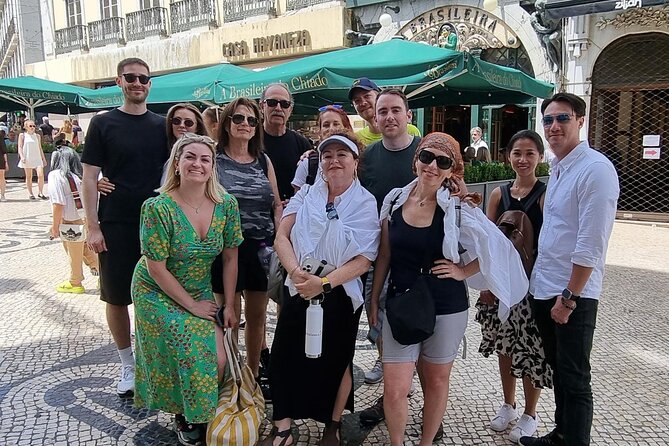
A brief stop at Avenida da Liberdade introduces Lisbon’s grandest avenue. The route does not linger for long, but the contrast is useful. You have just seen older squares and narrow historic streets. Here, the city presents a more formal boulevard associated with elegant architecture and upscale Lisbon.
Casa do Alentejo offers a different kind of surprise. The building is described as one of the city’s most charming houses, and it is a useful reminder that Lisbon’s character often hides behind plain entrances. The stop lasts about 10 minutes, giving the guide time to explain why the place matters.
This is one of the route’s strengths. You are not simply marching between the most famous postcard sights. The tour includes locations that might be easy to pass without understanding their role or character. Natalia, one of the guides praised for her local advice, is especially appreciated for pointing people toward inexpensive places to eat.
You should write down recommendations as you go. A two-and-a-half-hour walk gives you a lot of information, and restaurant names or neighborhood tips can be easy to forget once the tour ends.
Largo do Carmo and the Carnation Revolution
Largo do Carmo is among the most meaningful stops on the route. It is linked with the Carnation Revolution, the peaceful military-led movement that ended Portugal’s dictatorship in 1974.
The square also brings the earthquake story back into view through the ruins of Carmo Church. The roofless Gothic remains are one of Lisbon’s most striking sights, and the open sky above the old nave makes the damage visible in a way that a spoken explanation cannot match.
Expect about 10 minutes here. A strong guide can connect several layers of Lisbon’s past in one place: medieval religious architecture, the destruction of 1755, and the political events of the twentieth century.
This is where the tour feels most useful for a first visit. You are not only learning dates. You are seeing how natural disaster, religion, government, and modern democracy have all left marks on the same streets.
Rossio Station and São Roque Church
The walk continues to Rossio Station, the old central station of Lisbon. The stop is brief, around five minutes, but the building is worth noticing for its historic façade and its role as a gateway through the city.
From there, the group reaches Igreja de São Roque. This church is singled out because it survived the 1755 earthquake. That fact makes it a valuable comparison with Carmo Church, where the ruins tell a very different story.
The contrast between the two churches is one of the best teaching moments on the walk. At Carmo, you see destruction preserved in stone. At São Roque, you see a building that remained intact enough to continue its religious role. The guide can use both sites to explain how unevenly the earthquake affected Lisbon.
The walk is not described as extreme, but it is still a city tour through streets with slopes and uneven pavement. Wear shoes you can comfortably use for at least two and a half hours. Families with children and strollers have completed the route, though conditions may feel easier for some groups than others.
Camões Square and the edge of Bairro Alto
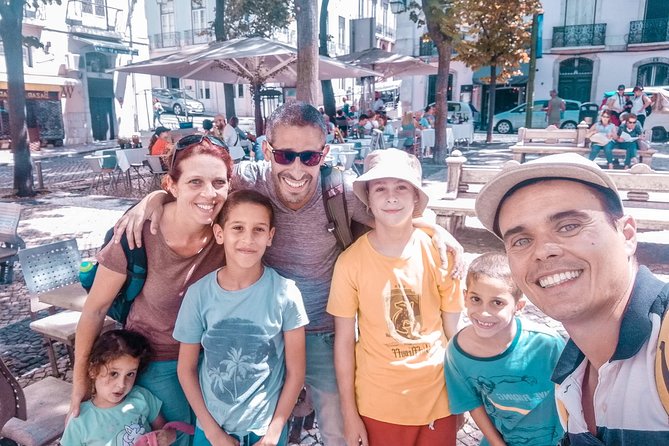
The final section leads to Praça Luís de Camões, one of Lisbon’s most recognizable squares. It marks the transition into Chiado and Bairro Alto, two areas with strong connections to nightlife, restaurants, and cultural life.
The tour ends around Camões Square rather than returning to Praça do Comércio. That is convenient if you plan to continue into Bairro Alto, look for dinner, or explore Chiado on your own. It is less convenient if you need to return immediately to the riverfront, though Lisbon’s public transportation network is nearby.
Bairro Alto is the final listed stop. The guide explains its role as Lisbon’s famous nightlife district, giving you a sense of how the neighborhood changes after dark. The tour itself ends before you need to make evening plans, so you can choose to stay in the area or head elsewhere.
Several guides are praised for restaurant recommendations and practical city advice. Tiago receives repeated praise for his food suggestions, while Natalia is noted for recommending inexpensive places. José is often described as friendly, entertaining, and well informed about the city. The precise quality of your final advice will depend on the guide, but it is worth asking direct questions before the group breaks up.
How the guide affects the experience
The guide is the central feature of this tour. The route is good, but the value comes from the explanations, stories, and personal suggestions layered onto each stop.
Tiago is repeatedly praised for passion, humor, storytelling, and a detailed list of places to eat and visit. José receives similar praise for his energy, friendliness, and ability to make history approachable. Natalia is appreciated for practical low-cost food advice and for making the past feel connected to the present. Walter is praised for being polite, funny, and helpful with a family using strollers.
There is one important weakness to keep in mind. At least two participants found a guide spoke too quickly and did not slow down after being asked. Accents and street noise can make that problem worse. If you are hard of hearing or need more time to follow spoken English, stay close to the guide and ask for repetition early.
The maximum group size is 20 people. That is reasonable for a city walk, but a full group can make it harder to hear in busy squares. Arriving at the meeting point a little early may help you position yourself near the guide.
What the $1.25 price really means
The advertised $1.25 booking cost makes this one of the cheapest ways to get an organized introduction to central Lisbon. But you should not treat it as a $1.25 guided tour in the ordinary sense.
The guide is paid through gratuities. You decide what the experience was worth at the end, but the company explains the tipping model at the start. One participant objected after a guide asked for a minimum of €10 per person. The guide’s expectation may not be presented in exactly the same way every time, but you should budget for a meaningful tip rather than assuming the small booking charge covers the service.
Even with that consideration, the value can be excellent if you want historical context and an efficient orientation. You see major landmarks, learn the basic story of Lisbon, and receive practical suggestions for the rest of your stay. A fixed-price tour may be a better choice if you want a clearly stated total cost from the beginning.
Rain, mobility, and booking details
The tour operates in rainy weather, so bring a rain poncho or umbrella. One participant completed it during persistent rain and still found the experience worthwhile. Lisbon’s weather can change, and the route includes outdoor squares with limited shelter.
Service animals are allowed, and the activity is near public transportation. Most people can participate, but this is still a walking tour through an old city center. Comfortable shoes are essential, especially if you are not accustomed to Lisbon’s slopes and stone pavements.
The tour is offered in English and uses a mobile ticket. Confirmation is provided when you book. You can cancel for a full refund up to 24 hours before the start time. Cancellations or changes made less than 24 hours ahead do not qualify for a refund, and the tour may be canceled if its minimum number of participants is not reached.
Who should book this Lisbon walking tour?
I would choose this tour during the first day or two of a Lisbon visit. It covers enough ground to help you understand where Baixa ends, how Chiado connects to Bairro Alto, and which streets deserve a second look.
It suits you best if you enjoy history explained outdoors, want restaurant and transportation tips, and prefer a guide who can answer questions along the way. It is also a sensible choice for budget-minded visitors, provided you understand the gratuity arrangement.
I would be more cautious if you want a slow photographic walk, a guaranteed small group, or a fixed final price. The route covers 15 stops in about two and a half hours, so some locations receive only five minutes. You will get an overview, not a long visit inside each site.
The experience has received a 4.8 rating from 538 reviews, with 97 percent recommending it. Those figures fit the main strengths: strong guides, useful orientation, and a lively introduction to Lisbon’s past. The main cautions are clear pricing expectations, occasional fast speaking, and the challenge of hearing in a larger group.
Final verdict: a smart first walk through Lisbon
Book this tour if you want to understand Lisbon before exploring it on your own. The route connects Praça do Comércio, Rossio, Santa Justa, Carmo, São Roque, Chiado, and Bairro Alto, while the guide supplies the links between them.
I especially like the way the tour combines practical help with difficult history. You learn where to eat and how the neighborhoods connect, but you also stop at the Jewish massacre memorial, the Carmo ruins, and sites tied to the Carnation Revolution. That gives Lisbon more depth than a simple landmark checklist.
Just remember that $1.25 is the booking charge, not necessarily your total cost. Bring comfortable shoes, protect yourself from rain, and ask the guide to slow down if needed. For a first look at central Lisbon, this is a strong-value introduction with enough history to shape the rest of your visit.
FAQ
Where does the Lisbon walking tour begin?
The tour begins at Praça do Comércio in Lisbon. Look for the guide with an orange umbrella between the large arch and the statue in the middle of the square.
Where does the tour end?
The tour ends around Praça Luís de Camões, also called Camões Square, at Largo Luís de Camões.
How long does the tour last?
The tour lasts approximately two hours and 30 minutes.
What language is the tour offered in?
The tour is offered in English.
What is included in the $1.25 price?
The booking provides access to the free walking tour. You pay the guide at the end according to what you feel the experience was worth.
Is a tip expected?
The tour operates through gratuities. Guides explain the system at the start, and one guide asked for a minimum of €10 per person.
What landmarks are visited?
The route includes Praça do Comércio, Municipal Square, Santa Justa Elevator, Rossio, Rua Augusta, the memorial to the victims of the 1506 Jewish massacre, Igreja de São Domingos, Avenida da Liberdade, Casa do Alentejo, Largo do Carmo, Rossio Station, São Roque Church, Camões Square, and Bairro Alto.
Is the tour suitable for most people?
Most people can participate, and service animals are allowed. The tour involves walking through central Lisbon, including historic streets and slopes.
Can the tour operate in the rain?
Yes. The tour can continue in rainy weather. Bring an umbrella or rain poncho.
How many people can join the tour?
The maximum group size is 20 people.
Can I cancel the tour?
You can cancel up to 24 hours before the start time for a full refund. Cancellations or changes made less than 24 hours before the start time are not refunded or accepted.
Just added around Lisbon
- Central Lisbon E-Bike Tour★ 5.0 · 168 reviews
- From Lisbon: Sintra and Cascais Full-Day Private Tour★ 4.9 · 168 reviews
- Experience the Queen of Fado at Ah Amália Living Experience★ 5.0 · 171 reviews
- Lisbon: 2-Hour Sunset Sailing Tour on Luxury Sailing Yacht★ 4.9 · 171 reviews
- Lisbon – Vinho Verde Wine Premium Boat Experience★ 5.0 · 171 reviews
- Óbidos: Medieval Tales & Secrets Spots Guided Walking Tour★ 4.9 · 171 reviews
- From Lisbon: Small Group Fátima & Little Shepherds Town Tour★ 4.8 · 171 reviews
- Horse Riding on the Beach★ 4.5 · 171 reviews
City Tours, compared.
Lisbon City Center Tour – The Unmissable Lisbon
Read our review →
Daytime/Sunset/Night City Sailboat Tour with Drink
Read our review →
City Highlights 3-Hour Guided Electric Bike Tour
Read our review →

Browse the lists this tour appears in