
Reviewed · FOOD & DRINK
Private group Lisbon Roots, Food & Cultural Walk
Lisbon tastes better on foot. This private food and culture walk links old squares, Fado landmarks, churches, and local tasting stops across Downtown and Mouraria. I like the way it connects Portuguese food with the city’s African, Indian, Jewish, and maritime influences, and I like that your guide can shape the pace for your own group. The main consideration is the price: at $325.60 per person, it is a serious splurge, especially for a small party.
You should also expect hills, cobblestones, steps, and about 2 kilometers of walking over three and a half hours. Still, the food-and-history mix earns strong marks, and guides such as Pedro, Dani, Daniel, and Ricardo are repeatedly praised for their humor, warmth, local knowledge, and ability to explain Portugal without turning the walk into a lecture.
In This Review
- What makes this Lisbon walk worth considering
- Why the Downtown to Mouraria route works
- São Domingos Church and Lisbon’s difficult past
- Santa Justa Elevator and the price of famous views
- Mouraria, Fado, and the city’s many voices
- Chapels, squares, and traces beneath the city
- Largo de São Domingos and the 1506 massacre
- What you eat and drink during the walk
- How the private format affects value
- Walking conditions and planning advice
- Who should book this Lisbon food walk?
- FAQ
- How long does the Lisbon Roots, Food & Cultural Walk last?
- How far do you walk?
- Is this a private tour?
- Where does the tour start?
- Where does the tour end?
- What is included in the price?
- Is hotel pickup available?
- Can dietary restrictions be accommodated?
- Should you book it?
What makes this Lisbon walk worth considering

- Mouraria is the heart of the route: You explore one of Lisbon’s most multicultural districts and the birthplace of Fado.
- More than 10 tastings are included: Food, wine, port, coffee, tea, snacks, and other Portuguese specialties are part of the experience.
- The route covers about 2 kilometers: It is not a long-distance hike, but hills and old stone streets make it moderately demanding.
- The group is private: You share the walk only with your own companions, with pickup available by arrangement.
- The history is not just decorative: São Domingos Church, the 1506 Jewish massacre memorial, and the Chapel of Our Lady of Health give the food stops real context.
- The finish is at Confeitaria Nacional: The walk ends at one of Lisbon’s best-known traditional pastry houses on Praça da Figueira.
Why the Downtown to Mouraria route works

The walk begins at Largo de São Domingos, a useful starting point in central Lisbon. From here, the route moves through the old Downtown area and toward Mouraria, tracing Lisbon from its medieval beginnings to modern city life.
This route works because it does not treat food as a separate activity. You see the streets and monuments that shaped Lisbon, then taste food connected to those places and the people who live there. The result is closer to an introduction to the city than a simple list of restaurant stops.
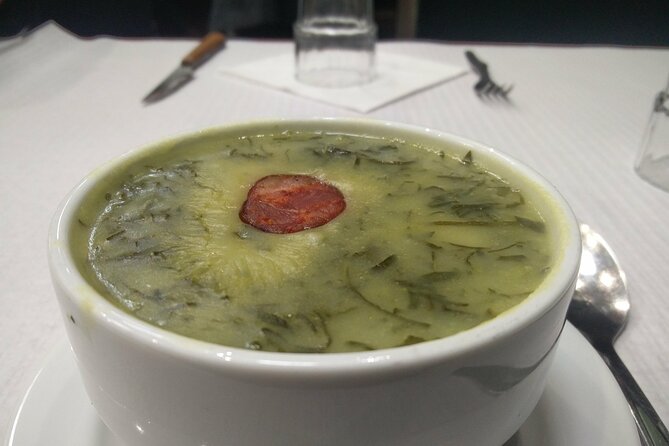
The tour includes six food stops and more than 10 tastings. The exact menu is not specified, so you should expect a broad sample of Portuguese food culture rather than a fixed meal with every item announced in advance. Past experiences included appetizers, soup, tapas, port, dessert, coffee, and drinks at several different venues.
That variety matters. A good food walk should help you understand how Portuguese cooking fits together, from small savory bites to sweets and fortified wine. It also means you should arrive hungry. The tastings may add up to a generous amount of food over three and a half hours.
More Food Tours in Lisbon
- Winner 2025 Undiscovered Lisbon Food & Wine Tour by Eating Europe
★ 5.0 · 6,390 reviews - Lisbon: Food and Wine Small Group Walking Tour
★ 4.9 · 4,082 reviews - Lisbon Small-Group Food Tour with 18 Tastings in Alfama District
★ 5.0 · 1,967 reviews
São Domingos Church and Lisbon’s difficult past
The first major sight is Igreja de São Domingos, a church with origins in the 13th century. It has been damaged by earthquakes several times and was badly affected by a major fire in 1959.
The church reopened in the 1990s after being closed for decades. Its interior is striking because the restoration remains simple. You can still sense the damage rather than seeing a polished reconstruction that hides the building’s past.
The stop itself is listed as only about five minutes, so do not expect a long church visit. Its value comes from the guide’s explanation and from seeing how Lisbon’s buildings carry scars from earthquakes, fire, religious conflict, and changing city life.
Nearby Rossio Square, formally Praça de D. Pedro IV, adds another layer. This has been one of Lisbon’s main gathering places since the Middle Ages, used for celebrations, revolts, bullfights, and executions. Today, you see flower sellers, shoppers, commuters, and people meeting in the center of town.
Rossio is also a place where the city can feel crowded. The route may pass through busy pedestrian areas, and you may need to stay close to your guide. That is a small tradeoff for being in one of Lisbon’s most useful central spaces.
Santa Justa Elevator and the price of famous views

The Elevador de Santa Justa is one of Lisbon’s most recognizable structures. Built in 1902 by Raoul de Mesnier du Ponsard, a Portugal-born French architect who apprenticed under Gustave Eiffel, the iron tower links the lower Downtown area with the higher Bairro Alto district.
The elevator rises 45 meters and was first powered by steam. Its Neo-Gothic design gives it a strong resemblance to Eiffel-era ironwork, though it is a distinctly Lisbon solution to the city’s steep streets.
The route pauses here only briefly, and admission is not included. That is important. You may see the elevator and hear its story, but the tour does not promise a ride or access to the upper viewing platform. If you want the panoramic view over Rossio, the castle, and the river, you may need to arrange that separately and allow extra time.
I like the way this stop explains a practical problem in Lisbon: getting from one level of the city to another. You also get a useful reminder that the prettiest landmarks are not always the most efficient way to move around.
Mouraria, Fado, and the city’s many voices

From Downtown, the walk heads into Mouraria. This district is described as the birthplace of Fado and one of Lisbon’s most multicultural neighborhoods.
At the Monumento Mouraria Berço do Fado, a carved Portuguese guitar honors the music’s roots in the neighborhood’s narrow streets. The monument also recalls Maria Severa, regarded as the first great Fado diva, Fernando Maurício, a major 20th-century Fado singer, Amália Rodrigues, and the many famous and unknown voices connected with Lisbon’s song.
This is one of the strongest cultural parts of the tour. Fado is not presented merely as a polished evening show. The story includes poor residents, hard lives, and the emotional directness that gave the music its force.
One guide, Pedro, is praised for his singing voice, so you might ask him to sing if the moment feels right. That is not a promised part of the tour, but it shows how much the quality of the experience can depend on your individual guide.
The route also passes Martim Moniz Square, a gateway to Mouraria and a place shaped by many cultures. The square is associated with Tram 28, which begins here and runs through Lisbon’s oldest districts. It is also described as having a mini Chinatown feel, with the castle visible above and many communities represented in the surrounding streets.
The tram connection is useful context, but this is not a Tram 28 ride. You are walking, and the tour does not include transportation between sights.
More Walking Tours in Lisbon
- Lisbon: History, Stories and Lifestyle Walking Tour
★ 4.8 · 10,902 reviews - Best of Lisbon Small-Group Guided Walking Tour
★ 5.0 · 4,869 reviews - Best of Lisbon Walking Tour: Rossio, Chiado & Alfama
★ 4.9 · 2,700 reviews - Age of Discoveries Walking Tour in Belém
★ 5.0 · 1,513 reviews
Chapels, squares, and traces beneath the city
Praça da Figueira gives the walk another food connection. Before the 1755 earthquake, the site held All Saints Hospital. Later, under the rebuilding plan led by the Marquis of Pombal, it became Lisbon’s main food market.
A covered market occupied the square from 1885 until the 1950s. Today, hotels, shops, and cafés fill the surrounding buildings, and the bronze equestrian statue of King João I provides the main visual marker.
This stop helps you see how food trade once shaped the center of Lisbon. It also makes the final stop at Confeitaria Nacional feel more connected to the city’s old commercial life rather than simply being a pastry finish.
The Chapel of Our Lady of Health is smaller and easier to miss. Built in 1505 by Lisbon garrison artillerymen, it was first dedicated to Saint Sebastian, protector against war, famine, and plague. In 1569, it became associated with Our Lady of Health, and the image of the Virgin arrived there in 1662.
The chapel suffered damage in the 1755 earthquake, though its early 18th-century portal is attributed to João Antunes. Each year, a thanksgiving procession takes place on the first Sunday of May, continuing a tradition that began in the 16th century.
The chapel is a good example of what this route does best. It brings you to a modest place that many people would walk past, then gives it meaning through local stories and religious tradition.
Largo de São Domingos and the 1506 massacre

The route returns to Largo de São Domingos, where the walk ends near some of Lisbon’s most painful historical memories. The square remains a meeting place for Lisbon residents and the African community, with cafés and small shops around it.
You also find A Ginjinha, the famous cherry liqueur shop. A tasting of this drink may be part of the broader food experience, but the exact stop-by-stop menu is not guaranteed. The tour does include alcoholic beverages, wine tasting, and coffee or tea.
The square is also home to a memorial for the victims of the 1506 Jewish massacre. During a period of drought, hunger, and plague, a claimed religious vision led to violence after a New Christian challenged the supposed miracle. The attack spread, and Jews across the city were accused of heresy.
The memorial’s mural, inaugurated in 2008, carries the words Lisbon, City of Tolerance in 34 languages. It honors the Jewish victims and forces a difficult question: how can a city remember injustice while presenting itself as welcoming today?
The same area was later connected with the Portuguese Inquisition, as people condemned to death were left waiting before being burned at Rossio. This is not light sightseeing, and that is precisely why it belongs on a cultural walk. You get a fuller picture of Lisbon, one that includes food, music, faith, migration, and persecution.
What you eat and drink during the walk

The tour includes more than 10 tastings at six stops. The published details name food tasting, wine tasting, alcoholic drinks, coffee or tea, and snacks, while specific food examples from past outings include appetizers, soup, tapas, port, dessert, and coffee.
You should think of this as a progressive tasting menu spread across the city. You are not seated for one long restaurant meal. Instead, you move between different places and sample a range of flavors while your guide explains what you are eating and why it matters.
Portuguese food has been shaped by local traditions and by contact with other parts of the world. The route’s focus on Mouraria gives that story a natural setting, since the neighborhood is known for its many cultures and communities.
The tastings can also help you plan the rest of your visit. Several people found the food stops useful for discovering places they would not have found alone, and guides provided recommendations for other good bets in Lisbon. I would treat that advice as part of the tour’s value, especially if you take the walk early in your stay.
Tell the company about dietary restrictions when you book. The tour notes that changes cannot be made on the day if those needs were not supplied in advance. Vegetarian food has been accommodated, but you should not assume every restriction can be handled without prior notice.
Alcohol is included at multiple stops. One past participant was surprised by how often alcohol appeared, so keep that in mind if you do not drink, are traveling with children, or plan to drive afterward. Coffee and tea are also included, but the exact nonalcoholic choices should be confirmed when booking.
How the private format affects value
The listed price is $325.60 per person. That is high for a three-and-a-half-hour walking tour, even with food and drinks included.
The private format explains some of the cost. Only your group participates, so you are not tied to a large public schedule. You can ask more questions, spend more time on subjects that interest you, and set a pace that works for your companions. Pickup is offered, though hotel drop-off is not included, and transportation to and from attractions is also not included.
The value improves for a larger private group, particularly if you want a special family or friend-group activity. For two people, the per-person cost is harder to justify unless personal attention and food variety are your top priorities.
The experience receives a 4.9 rating from 152 reviews, with 97 percent recommending it. The strongest praise centers on the guides. Pedro is described as funny, courteous, and well informed. Dani is praised for energy and clear explanations, while Daniel is noted for arriving early, outlining the plan, and sharing Lisbon from a local point of view. Ricardo is also singled out for explaining cultural subtleties along with the food.
Those details matter because a food walk can be ordinary if the guide only points at buildings and hands you samples. Here, the guide appears to be a major part of what you are paying for.
Walking conditions and planning advice
The route covers about 1.2 miles, or 2 kilometers, but distance alone does not tell the whole story. Lisbon’s old streets include uphill walking on cobblestones and steps going down through historic neighborhoods.
The stated physical level is medium. You should have moderate fitness and wear shoes with a firm grip. Bring water, especially in warm weather, though the tastings and pauses break up the walking.
The walk lasts approximately three hours and 30 minutes. Some earlier experiences took close to four hours, so avoid scheduling a train, museum entry, or airport transfer immediately afterward.
The starting point is Largo de São Domingos. The official end is Confeitaria Nacional at Praça da Figueira, open Monday through Saturday from 9:30 a.m. to 8:30 p.m. The route is near public transportation, but no transport between stops is included.
A private booking may also suit families. One group included two 12-year-old children, and the manageable group size helped keep the outing organized. Still, the combination of hills, steps, alcohol tastings, and historical subjects means you should decide if it matches your children’s interests and stamina.
Free cancellation is available if you cancel at least 24 hours before the local start time. Cancellations inside that window are not refunded, and late changes are not accepted.
Who should book this Lisbon food walk?
I would choose this tour if you want your first serious introduction to Lisbon to combine eating with local context. It suits people who like to ask questions, walk through older neighborhoods, and learn why a dish, drink, song, or square matters.
It is especially useful early in a Lisbon visit. You can collect restaurant ideas, learn the city’s central layout, and get an introduction to Mouraria before exploring it on your own.
I would be more cautious if you want a low-cost food crawl, a long sit-down meal, or a tour with no alcohol. The price is substantial, and the physical demands are real despite the short distance. The food list is broad but not fully specified, so anyone seeking a precise menu should ask before booking.
FAQ
How long does the Lisbon Roots, Food & Cultural Walk last?
The experience lasts approximately three hours and 30 minutes. Some past outings took close to four hours, so allow extra time after the scheduled finish.
How far do you walk?
The route covers about 1.2 miles, or 2 kilometers. It includes uphill walking on cobblestones and steps descending through old Lisbon streets.
Is this a private tour?
Yes. Only your group participates in the activity.
Where does the tour start?
The meeting point is St. Dominic’s Square, also called Largo São Domingos, in Lisbon.
Where does the tour end?
The walk ends at Confeitaria Nacional, Praça da Figueira 18B, Lisbon.
What is included in the price?
Food tastings, a local guide, wine tasting, alcoholic beverages, coffee or tea, and snacks are included.
Is hotel pickup available?
Pickup is offered. Hotel drop-off is not included, and transportation to or from the attractions is not included.
Can dietary restrictions be accommodated?
You must provide dietary restrictions in the booking form. The company states that it cannot adapt the tastings on the day if you do not give advance notice.
Should you book it?
Book this walk if you want a personal introduction to Lisbon’s food, Fado, and difficult past, and if your budget allows for a private experience. The strongest reason to choose it is the combination of tasting stops and places such as Mouraria, São Domingos Church, the Our Lady of Health Chapel, and the 1506 massacre memorial.
Skip it if you are watching costs closely, avoiding alcohol, or unable to manage steep cobblestone streets. For everyone else, especially a small group that values a lively local guide and a full first taste of Lisbon, this is a thoughtful and flavorful way to get your bearings.
More Guided Walks
- Sintra & Cascais Day Tour with Pena Palace Entry and Gardens Walk
★ 5.0 · 962 reviews - Lisbon Roots – Small group Food & Culture Walking Tour w/tastings
★ 5.0 · 910 reviews - Lisbon: Starter Walking Tour to the highlights in German
★ 4.9 · 781 reviews - Lisbon Tram No. 28 Ride & Walking Tour
★ 4.1 · 766 reviews
More Portuguese Food and Wine Outings
- Lisbon: Baixa District Food Tour with Dinner and Drinks
★ 4.9 · 1,870 reviews - Devour Lisbon: The Ultimate Portuguese Food Tour
★ 5.0 · 1,782 reviews - Lisbon Food Tour with 10+ Tastings of Local Delicacies & Wines
★ 5.0 · 1,339 reviews - Award-Winning Original Lisbon Food Wine Tour: 19 Curated Tastings
★ 5.0 · 1,288 reviews
Just added around Lisbon
- Tuk tuk tour in Belem area★ 5.0 · 46 reviews
- Lisbon: Private Tour Sintra, Cabo da Roca and Cascais★ 4.9 · 46 reviews
- Private Sintra Tour from Lisbon★ 5.0 · 46 reviews
- Premium Porto Private Day Trip from Lisbon with Local Guide★ 5.0 · 47 reviews
- 4 Hours Tuktuk City Tour in Lisbon★ 5.0 · 47 reviews
- Small Group Pena Palace, Sintra, Regaleira and Cascais★ 5.0 · 47 reviews
- From Lisbon: Tour to Fátima, Batalha, Nazaré and Óbidos★ 4.6 · 47 reviews
- DayTrip from Lisbon to Sintra+Cascais PRIVATE TOUR-small groups★ 5.0 · 47 reviews
Food & Drink, compared.
Douro Valley w/ Boat Tour, Wine Tasting & Lunch
Read our review →
Winner 2025 Undiscovered Lisbon Food & Wine Tour by Eating Europe
Read our review →
Cálem Cellar Tour, Interactive Museum & Wine Tasting
Read our review →

Douro Valley Small-Group Tour with Wine Tasting, Lunch and Boat
Read our review →
Browse the lists this tour appears in