

Reviewed · WALKING TOURS
3-Hour Private Guided Walking Tour of Lisbon
Lisbon reveals itself one hill and viewpoint at a time. This private walk links Rossio, Mouraria, Alfama, Baixa, and Chiado, giving you a useful first look at the city’s central districts in just three hours. I like the small group size, which allows the guide to keep the pace personal, and I like the mix of major sights with local corners such as A Ginjinha and the Mouraria fado area. The main consideration is the amount of ground covered: Lisbon is hilly, and the schedule is full.
The tour is priced at $204.38 per group of up to eight, not per person. That can be good value for a family or group of friends, but less so for one or two people. The supplied information also says the experience is in French only, despite a separate listing of English as an offered language, so I would confirm the language before paying.
In This Review
- Key points at a glance
- Starting beneath the Rossio station façade
- Praça da Figueira and the church with a scarred interior
- Mouraria’s lanes and the climb to Chão do Loureiro
- Alfama, Santa Luzia, and Portas do Sol
- Lisbon Cathedral and the rebuilt Baixa
- Praça do Comércio beside the Tejo
- Finishing in Chiado at Praça Luís de Camões
- What the $204.38 group price really means
- Timing, language, and practical comfort
- Who should choose this Lisbon walk?
- Should you book it?
- FAQ
- How long is the walking tour?
- How many people can join the private tour?
- Where does the tour start?
- Where does the tour finish?
- Is the tour offered in English?
- Can I cancel for a full refund?
Key points at a glance
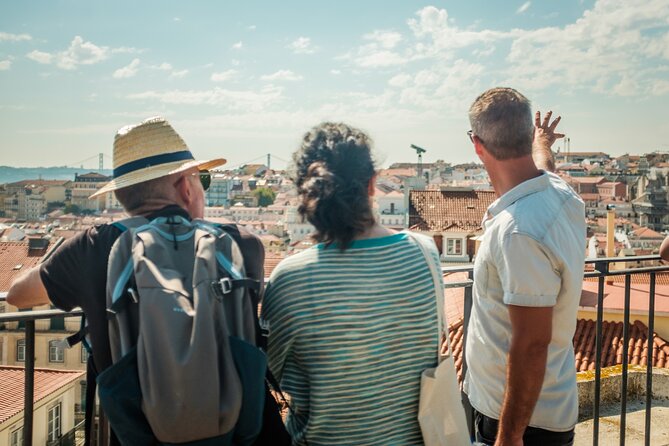
- Sixteen central Lisbon stops in about three hours: The route covers Rossio, Mouraria, Alfama, Baixa, and Chiado without charging separate admission for the listed stops.
- A genuinely private experience: Only your group participates, with a maximum of eight people.
- Strong emphasis on Lisbon’s viewpoints: Chão do Loureiro, Santa Luzia, and Portas do Sol give you different angles over the old city.
- A useful introduction to fado culture: Mouraria includes the Monumento Mouraria Berço do Fado and a Fado Vadio graffiti wall.
- A guide-led experience with a personal touch: Pedro is praised for his friendly manner and passion for Lisbon’s past.
- A practical end point in Chiado: The walk finishes at Praça Luís de Camões, a handy place to continue exploring on your own.
Starting beneath the Rossio station façade
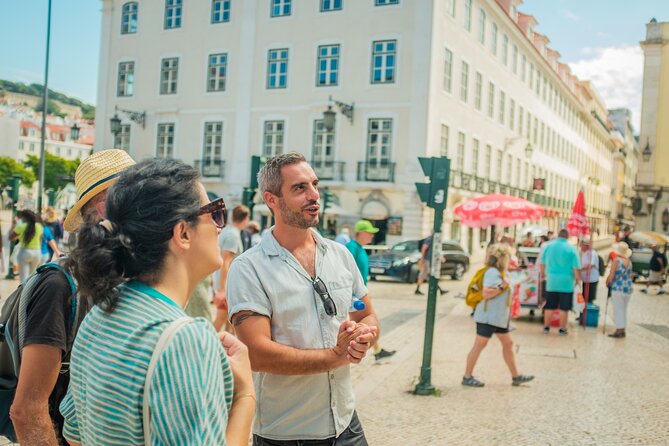
The meeting point is beside the statue at the foot of Teatro Nacional Dona Maria II in Praça Dom Pedro IV. This is a central and easy-to-recognize starting place, close to Estação do Rossio and public transportation.
Your first stop is Estação do Rossio, often called the most beautiful railway station in Lisbon. Even if you are not catching a train, take a moment to study the ornate façade and its horseshoe-shaped entrances. The station sets the tone for the walk: Lisbon often places grand architecture directly beside ordinary city life.
From there, the route moves into Praça Dom Pedro IV, usually called Rossio. This is one of Lisbon’s key squares, with patterned paving, a central statue, and a constant flow of people crossing the city center. Ten minutes is enough for an introduction, but not for a long architectural talk, so listen closely if the guide points out details.
A short stop at A Ginjinha adds a useful local flavor. This is an authentic place to try ginjinha, Lisbon’s traditional sour-cherry liqueur. The visit is listed as five minutes, so think of it as a quick cultural pause rather than a full tasting session. If you do not drink alcohol, the stop can still help explain one of the city’s best-known traditions.
More Walking Tours in Lisbon
- Lisbon: History, Stories and Lifestyle Walking Tour
★ 4.8 · 10,902 reviews - Best of Lisbon Small-Group Guided Walking Tour
★ 5.0 · 4,869 reviews - Lisbon: Food and Wine Small Group Walking Tour
★ 4.9 · 4,082 reviews
Praça da Figueira and the church with a scarred interior
Next comes Praça da Figueira, described as the smaller sister of Rossio. The two squares sit close together, but they have different proportions and moods. Seeing them in sequence helps you understand how Lisbon’s central core is arranged.
I especially like the inclusion of Igreja de São Domingos. It is a small church, yet it is not a throwaway stop. Its interior carries visible marks from fire damage, giving the building a solemn, unusual character. The visit is listed at fifteen minutes, which should allow time to look around without turning the tour into a long church visit.
The route then turns toward Mouraria, one of Lisbon’s most distinctive districts. Mouraria is closely linked with fado, the Portuguese music known for its emotional singing and themes of longing. At the Monumento Mouraria Berço do Fado, the guide can place the neighborhood within that musical tradition.
A nearby Fado Vadio graffiti wall adds a modern note. The phrase refers to informal or amateur fado, and the painted wall gives you something visual to connect with the neighborhood’s musical identity. This pairing is one of the tour’s better choices: you get both a formal monument and a piece of street art.
Mouraria’s lanes and the climb to Chão do Loureiro
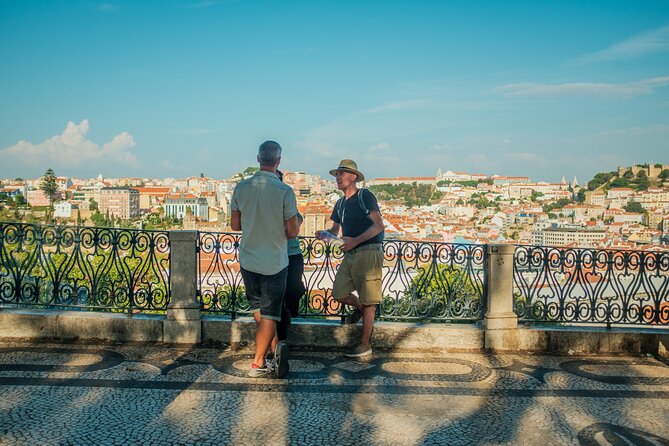
Mouraria is not presented as a polished postcard district. That is part of its value. You walk through an area associated with fado and see how Lisbon’s older quarters differ from the broad, orderly streets of Baixa.
The route then reaches Miradouro Chão do Loureiro, a belvedere with a view over Lisbon’s central area. Viewpoints are essential to understanding this city. From above, the tight streets, tiled roofs, church towers, and broad riverfront begin to make sense.
The practical warning is simple: Lisbon is built on hills. Even though the tour lasts only about three hours, you should expect uneven paving and some uphill movement. Wear shoes with a firm grip, and do not treat this as a flat stroll through a museum district.
The guide’s role matters here. Pedro is praised for being friendly and passionate about Lisbon’s past, and that style suits a route with many short stops. You are not spending a full hour at one monument. Instead, you need clear explanations that connect one neighborhood to the next.
Alfama, Santa Luzia, and Portas do Sol
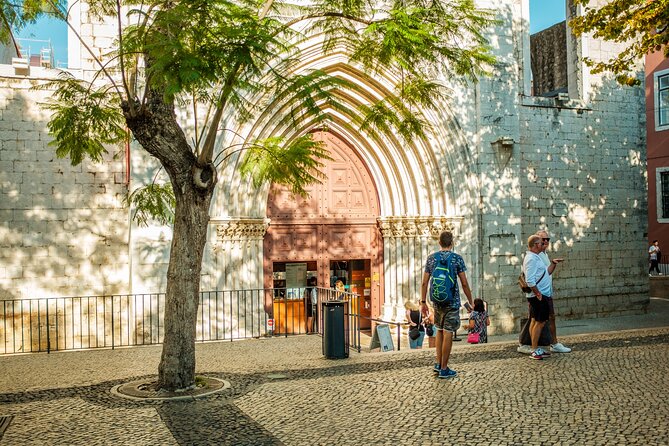
From Chão do Loureiro, the tour continues to Alfama, Lisbon’s best-known old district. The fifteen-minute visit gives you a taste of the area’s narrow streets and timeless character. Alfama is not one single attraction. It is a district to absorb gradually, with small lanes, shifting views, and a strong sense of age.
You should keep your expectations realistic. A fifteen-minute Alfama stop cannot cover the whole neighborhood. What it can do is show you why Alfama deserves a longer return visit, especially if you want to explore at a slower pace.
Miradouro de Santa Luzia is one of the tour’s major visual moments. The viewpoint looks across Alfama and provides a broad view of the old district. Its position makes it useful early in your Lisbon visit, since you can begin to recognize the area from above before wandering through it later.
Just beside it, Miradouro das Portas do Sol offers another angle. These two viewpoints are close together, but visiting both is worthwhile because the view changes with your position. One can feel almost like a continuation of the other, yet each helps you read Alfama’s layout differently.
The two stops also give the group a natural pause after the walk through Mouraria. Use the time to take photographs, but do not spend every minute looking through your phone. The point is to see how Alfama climbs toward the viewpoints and falls away toward the river.
More guided walks:
- Best of Lisbon Walking Tour: Rossio, Chiado & Alfama
★ 4.9 · 2,700 reviews - Age of Discoveries Walking Tour in Belém
★ 5.0 · 1,513 reviews - Sintra & Cascais Day Tour with Pena Palace Entry and Gardens Walk
★ 5.0 · 962 reviews - Lisbon Roots – Small group Food & Culture Walking Tour w/tastings
★ 5.0 · 910 reviews
Lisbon Cathedral and the rebuilt Baixa
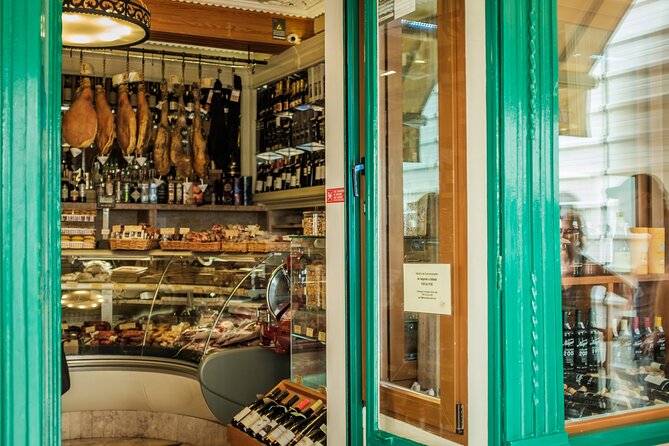
Lisbon Cathedral follows the viewpoints. The tour describes it as the city’s most beautiful church, though that judgment is personal. What is certain is its importance as a major religious landmark in the center of the old city.
The stop is listed at fifteen minutes. Admission is shown as free for the tour stop, but the supplied information does not promise a full interior visit or special access. Ask the guide what can be seen during the visit rather than assuming that the tour includes an extended look inside.
From the cathedral, the route moves toward Baixa de Lisboa. This is Lisbon’s central district, rebuilt after the earthquake of 1755. Its broad streets and more regular layout feel different from Alfama’s irregular lanes.
That contrast is one of the most useful lessons of the walk. In a short distance, you move from an old hillside district to a planned central area shaped by reconstruction. You can see why Baixa feels more spacious and organized, while Alfama feels more enclosed and layered.
A guide adds value here by explaining the change rather than simply pointing to buildings. The details of the earthquake and rebuilding give the streets a reason for looking the way they do. This is also a good section for orientation, since Baixa connects several central neighborhoods and major squares.
Praça do Comércio beside the Tejo
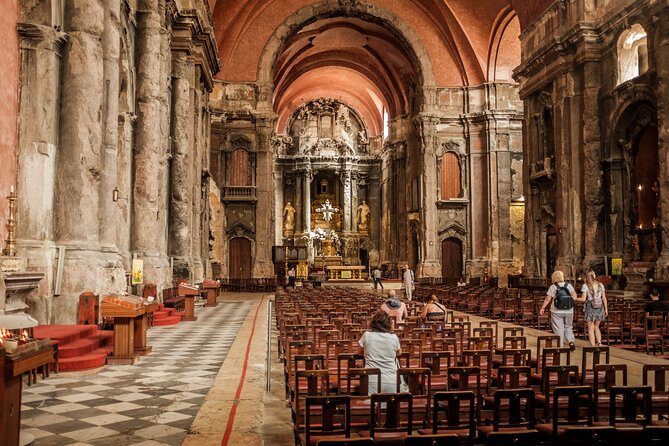
The route ends its Baixa section at Praça do Comércio, also known as Terreiro do Paço. This is Lisbon’s grand riverfront square, opening toward the Tejo. Its scale provides a sharp contrast with the tight lanes earlier in the walk.
Fifteen minutes is a sensible amount of time for a first visit. You can admire the square, look toward the river, and take in the surrounding arcades without losing too much time. The setting also helps explain Lisbon’s long connection with trade, shipping, and river travel, though the guide’s exact commentary will shape how much historical detail you receive.
I like this stop because it gives the walking route a clear visual payoff. The tour begins among central squares and old streets, rises toward viewpoints, then arrives at a broad open space beside the water. You get several versions of Lisbon in one compact route.
Still, the short timing means you may want to return later. Praça do Comércio deserves a slower look, especially if you want photographs or time under the arcades. The tour gives you orientation, not a long independent visit.
Finishing in Chiado at Praça Luís de Camões
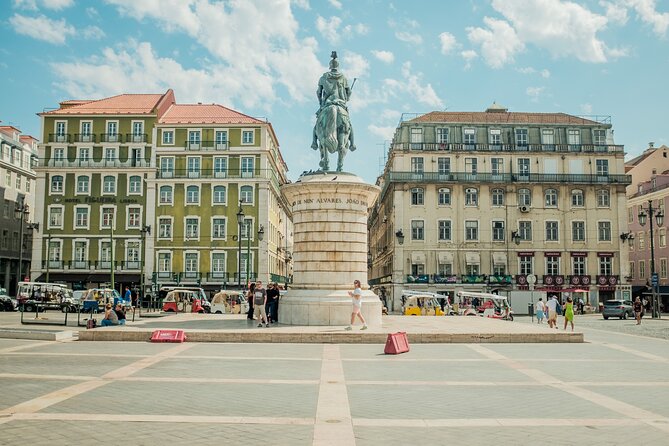
The final neighborhood is Chiado, Lisbon’s more polished and fashionable central quarter. After Mouraria, Alfama, and Baixa, Chiado provides another change in character. The district is associated with shops, cafés, cultural life, and grand urban spaces, though this tour offers only a ten-minute introduction.
The walk finishes at Praça Luís de Camões, at the foot of the statue. This is a useful ending point rather than an isolated drop-off. You can continue through Chiado, head toward other central sights, or simply stop for a break after the hills.
The square itself is emblematic of Lisbon and gives the tour a strong final marker. Ending here also makes sense geographically, since Chiado is close to other central areas. You are not left at an obscure street corner.
Because the route finishes in Chiado, plan your next activity before you start. If you want a meal, shopping, or more sightseeing, you will already be in a convenient part of the city. The tour does not include a return transfer, and the experience is built as a walking route from start to finish.
What the $204.38 group price really means
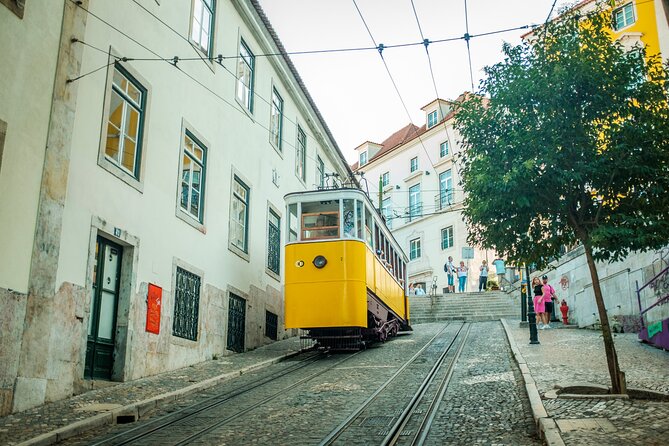
The listed price is $204.38 for up to eight people. At the maximum group size, that works out to about $25.55 per person. For a family or group of friends, that is a reasonable price for three hours with a private guide.
For one or two people, the calculation changes. You are paying for privacy and a dedicated guide rather than joining a larger public walk. That can still be worthwhile if you want to ask questions, keep the pace suited to your group, or avoid being mixed with strangers.
All listed stops show free admission, so the price is mainly paying for the guide’s time and route planning. A ginjinha purchase, if you choose one, is not stated as included. I would also not assume that church entry or any food and drink is covered beyond the walking experience itself.
The maximum group size of eight is a strong middle ground. It is private without being unwieldy, and it should be easier to hear the guide than in a large coach-style group. The quality of the experience will depend heavily on the guide, which is why Pedro’s friendly manner and enthusiasm for Lisbon are important positives.
Timing, language, and practical comfort
The experience is advertised as about three hours. The individual stop times add up to roughly three hours and ten minutes, before allowing for walking between locations. In practice, the guide may adjust the time at each place, especially if the group needs more time at a viewpoint or moves slowly on the hills.
The schedule is busy. Sixteen stops create variety, but you should not expect a long visit inside every church or a detailed tour of every district. I would choose this for orientation and local context, then return independently to the places that catch your attention.
The language needs checking. The detailed information says French only, while another part of the supplied details lists English as an offered language. Those statements conflict, so confirm the language directly before booking. A private tour is only useful if you can follow the explanations comfortably.
The tour is near public transportation, and service animals are allowed. Most people can participate, but the route’s hills and uneven streets remain worth considering. If you have limited walking ability, ask for clarification before booking, since no detailed accessibility information is provided.
Confirmation is sent within 48 hours, subject to availability. Free cancellation is available until 24 hours before the start time. Changes or cancellations inside that final 24-hour period are not accepted for a refund.
Who should choose this Lisbon walk?
I would recommend it to first-time visitors who want a clear introduction to central Lisbon without spending a full day on one museum or monument. It also suits families and friend groups that can share the private price.
The route works especially well for people interested in neighborhoods, viewpoints, fado, and city design. You see major squares, a station, a cathedral, a riverfront plaza, and several old districts in one outing.
It is less suitable if you want a slow photographic walk or a long interior visit at each church. The route is compact but ambitious, and the hills make the three-hour schedule feel active.
I also like it for a first or second day in Lisbon. The viewpoints help you understand the city’s shape, while the neighborhoods give you ideas for later visits. You may finish with a longer list of places to explore, which is exactly what a good orientation walk should do.
Should you book it?
Book this private walk if you want a brisk, guide-led introduction to Lisbon’s central districts, especially with a group of up to eight. The best parts are the private format, the three different viewpoints, the Mouraria fado connection, and a route that ends in useful central Chiado.
Think twice if you need an English-language tour without further confirmation, prefer a flat route, or want detailed time inside every landmark. Confirm the language, wear solid walking shoes, and treat the tour as a well-packed introduction rather than the final word on Lisbon.
FAQ
How long is the walking tour?
The experience lasts approximately three hours. The listed stop times add up to slightly more than three hours, so the guide may adjust the pace and time spent at individual locations.
How many people can join the private tour?
The price covers one private group of up to eight people. Only your group participates.
Where does the tour start?
The meeting point is at Teatro Nacional Dona Maria II, in Praça Dom Pedro IV, 1100-201 Lisbon, near the foot of the statue.
Where does the tour finish?
The tour ends at Praça Luís de Camões, 1200-243 Lisbon, at the foot of the statue.
Is the tour offered in English?
The supplied details conflict. One section lists English as an offered language, while the additional information says French only. Confirm the language before booking.
Can I cancel for a full refund?
Yes. You can cancel at least 24 hours before the experience start time for a full refund. Cancellations or changes made less than 24 hours beforehand are not accepted for a refund.
More 3-Hour Experiences
- Lisbon: 3-Hour Tour by E-Bike
★ 4.8 · 1,150 reviews - 3-Hour Lisbon 7 Hills Electric Bike Tour
★ 5.0 · 818 reviews - 3-Hour Guided Street Art Walking Tour of Lisbon
★ 5.0 · 278 reviews - Lisbon: 3-Hour The Slave Trade – An Historical Walking Tour
★ 4.9 · 179 reviews
Just added around Lisbon
- Tuk tuk tour in Belem area★ 5.0 · 46 reviews
- Lisbon: Private Tour Sintra, Cabo da Roca and Cascais★ 4.9 · 46 reviews
- Private Sintra Tour from Lisbon★ 5.0 · 46 reviews
- Premium Porto Private Day Trip from Lisbon with Local Guide★ 5.0 · 47 reviews
- 4 Hours Tuktuk City Tour in Lisbon★ 5.0 · 47 reviews
- Small Group Pena Palace, Sintra, Regaleira and Cascais★ 5.0 · 47 reviews
- From Lisbon: Tour to Fátima, Batalha, Nazaré and Óbidos★ 4.6 · 47 reviews
- Private 4 hour Sintra Tour★ 5.0 · 47 reviews
Walking Tours, compared.

Best of Lisbon Small-Group Guided Walking Tour
Read our review →
Porto Walking Tour, Lello Bookshop, River Cruise and Cable Car
Read our review →

Best of Lisbon Walking Tour: Rossio, Chiado & Alfama
Read our review →
Experience Porto’s Charm: 3-Hour Guided Walking Tour
Read our review →
Enjoy a Guided Levada Walk in the Rabaçal Valley
Read our review →Browse the lists this tour appears in